The Best Dough Mixers for Pizza, and When You Do Not Need One
The KitchenAid Artisan 5 quart at $475.00 is the best dough mixer for most home pizza bakers: it handles about 1,000 g of finished dough, which is four 250 g balls, on speed 2 for six to ten minutes. Spiral machines such as the $599.00 Ooni Halo Core fold dough instead of dragging it and add far less friction heat, which matters if you are chasing a 75F to 78F final dough temperature. Under about eight balls a week, hand mixing is genuinely the right answer.
Pizza dough is the hardest thing a domestic mixer is ever asked to do, and almost nobody sells it that way. A 60 percent hydration dough is stiff, elastic and heavy, and it fights the machine for the whole mix in a way a cake batter or a 75 percent hydration bread dough never does. That single fact reorders the category: bowl volume matters less than the shape of the action, and the honest capacity of any mixer for pizza is roughly half what the box says.
Do you actually need a dough mixer for pizza?
Probably not, and this page should say so before it sells anything. Pizza dough is one of the easiest doughs in the world to mix by hand, because time does most of the work.
Combine the flour and water, leave it covered for 30 minutes, and the flour hydrates and the gluten network begins forming on its own. That rest is called an autolyse, and it removes most of the kneading a recipe would otherwise ask for. Add the salt and yeast afterwards, work the dough for three or four minutes, then do two or three sets of stretch and folds spaced 20 minutes apart. Total hands-on time is under ten minutes and the result is indistinguishable from a machine mix.
What a mixer genuinely buys you is volume and repeatability. Twelve balls by hand is real work. Twelve balls in a machine is five minutes of attention, and every batch gets the same mix time, the same speed and the same final dough temperature. That consistency is what separates a good session from a repeatable one, and it is the reason to spend the money.
Buy in this order: a 0.1 g digital scale at $16.99, a bench scraper at $14.95, a graduated 6 quart container at $25.50 for the bulk ferment, then latching dough boxes at $24.99 for the balls. All four together cost less than a fifth of the cheapest mixer here and improve your pizza more.
The picks, by tier

Hamilton Beach 4 Quart Electric Stand Mixer with Dough Hook
A real dough hook and a 4 quart bowl for about a quarter of the price of a KitchenAid. It will mix roughly 700 g of finished dough at 62 percent hydration, and it will complain if you push past that, so treat the stated capacity as the ceiling rather than a starting point.
Best for: Two to four dough balls at a time, once or twice a month.
Check price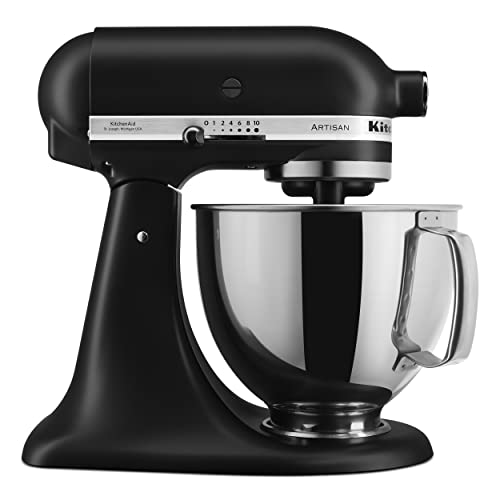
KitchenAid Artisan 5 Quart Tilt-Head Stand Mixer, KSM150PS
The default kitchen mixer, and it handles pizza dough acceptably if you keep the batch under about 1,000 g and stay on speed 2. It is a planetary mixer, so it drags dough around a fixed bowl rather than folding it, which means it warms the dough faster than a spiral machine does.
Best for: A mixer that has to make cakes and bread as well as pizza dough.
Check price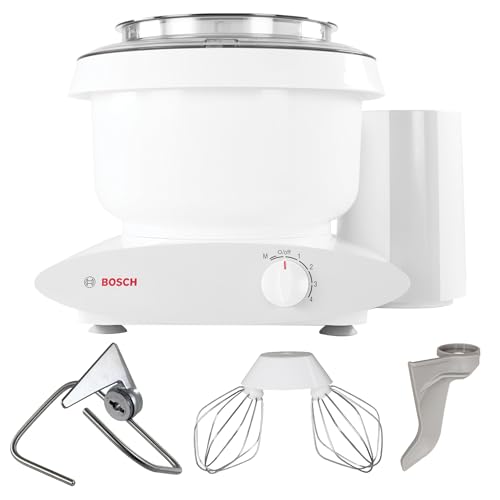
Bosch Universal Plus 6.5 Quart Stand Mixer, 500 Watt
A bottom-drive bowl with a wide dough hook, which is a much better shape for stiff dough than a tilt-head planetary machine and stays cooler through a long mix. It will take roughly twice the dough of a 5 quart tilt-head without straining.
Best for: Batches of eight to twelve dough balls at a time.
Check price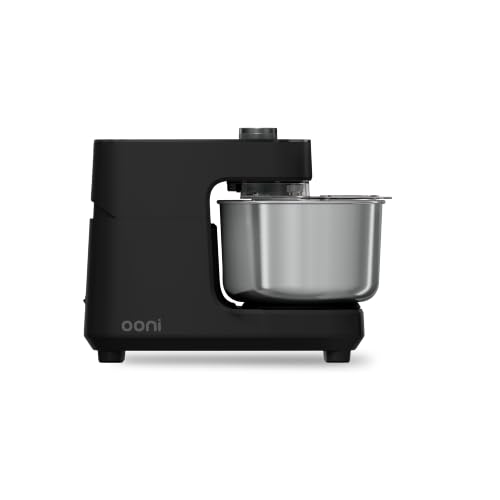
Ooni Halo Core Spiral Dough Mixer, 4.8 Quart
A genuine spiral action in a domestic footprint: the hook turns in one place while the bowl rotates under it, so the dough is folded rather than dragged. That develops gluten with much less friction heat, which is the whole reason pizzerias do not use planetary mixers.
Best for: Pizza-first bakers who want spiral action without a commercial machine.
Check price
Ooni Halo Pro Spiral Dough Mixer, 7.3 Quart
The largest spiral bowl in the domestic class, with a removable bowl and fine speed control so you can mix slowly enough to keep final dough temperature under 78F. It is a single-purpose machine and that is the point.
Best for: Twelve or more balls at a time, every week, by someone who tracks dough temperature.
Check pricePrices change often, confirm on Amazon. As an Amazon Associate we earn from qualifying purchases.
What is the difference between a planetary and a spiral mixer?
It is the single most important thing on this page, and it is a difference of mechanism rather than of quality.
A planetary mixer holds the bowl still and drags a hook around it in an orbit, the way a planet moves around a sun while spinning on its own axis. The dough is pulled, smeared and stretched against the bowl wall. It works, and it is why a KitchenAid can make bread. It also generates a lot of friction, and friction becomes heat in the dough.
A spiral mixer does the opposite. The hook stays in one place and turns, while the bowl rotates underneath it, usually with a fixed bar in the centre to divide the mass. The dough is repeatedly folded through itself rather than dragged around. Gluten develops faster, the mix is shorter, and the dough gains far less heat. This is what commercial pizzerias use, and it is not snobbery, it is the reason their dough leaves the mixer at a temperature they chose.
A bottom-drive mixer such as the Bosch Universal Plus at $499.00 sits between the two. The drive comes up through the base of the bowl rather than down from an arm, which gives it a far better mechanical advantage on stiff dough than a tilt-head machine of the same rating and keeps it noticeably cooler through a long mix.
How much dough can each mixer actually handle?
The figures below are practical stiff-dough capacity rather than manufacturer bowl ratings, because almost no manufacturer publishes a pizza dough figure. The working rule is roughly 200 g of finished dough per quart of bowl volume in a tilt-head planetary machine, and roughly 300 g per quart in a bottom-drive or spiral machine, because those designs are not fighting the dough the same way. Balls are counted at 250 g, the standard for a 12 inch pizza.
| Mixer | Action | Bowl | Practical dough | 250 g balls | Price |
|---|---|---|---|---|---|
| Hamilton Beach 4 qt | Planetary, tilt head | 4 qt | 800 g | 3 | $118.29 |
| KitchenAid Artisan | Planetary, tilt head | 5 qt | 1,000 g | 4 | $475.00 |
| Bosch Universal Plus | Bottom drive | 6.5 qt | 1,950 g | 7 | $499.00 |
| Ooni Halo Core | Spiral | 4.8 qt | 1,450 g | 5 | $599.00 |
| Ooni Halo Pro | Spiral | 7.3 qt | 2,200 g | 8 | $799.00 |
Two things fall out of that table. The Hamilton Beach 4 quart at $118.29 is a three-ball machine, which is a real family batch and nothing more. And the Ooni Halo Core at $599.00 holds more usable pizza dough than the larger-bowled KitchenAid Artisan at $475.00, purely because the spiral action is not wrestling the dough around a fixed bowl. Bowl volume alone is a poor guide.
Convert a ball count into an actual recipe on the dough ball weight calculator, which handles the grams-per-square-inch rule: 2.0 to 2.3 g per square inch for Neapolitan, 2.4 to 2.9 for New York, 3.2 to 3.8 for Detroit and pan styles. A 12 inch pizza is 113.1 square inches, so 113.1 multiplied by 2.2 gives 249 g, which is where the 250 g ball comes from.
How do you stop a mixer overheating the dough?
By choosing the water temperature deliberately rather than running the tap. This is the single technique that makes a mixer worth owning, and it is arithmetic rather than skill.
Aim for a final dough temperature of 75F to 78F. Yeast activity roughly doubles for every 17F rise in dough temperature, so a dough that leaves the mixer at 85F rather than 77F is fermenting substantially faster than whatever schedule you planned. That is how a 24 hour cold ferment turns into an over-proofed, alcohol-smelling mess by hour eighteen.
The standard straight-dough formula for a three-factor mix is:
Water temperature = (desired dough temperature x 3) minus (flour temperature plus room temperature plus friction factor).
Friction factor is what the machine adds. As a working starting point, use about 24F for a tilt-head planetary mixer on speed 2 for ten minutes, about 18F for a spiral or bottom-drive machine, and about 10F for hand mixing. Those are approximations to be calibrated against your own machine, not constants.
| Mix method | Friction factor | Flour temp | Room temp | Water needed for 78F dough |
|---|---|---|---|---|
| Hand mixing | 10F | 70F | 72F | 82F |
| Spiral or bottom drive | 18F | 70F | 72F | 74F |
| Planetary, speed 2, 10 min | 24F | 70F | 72F | 68F |
| Planetary, warm kitchen | 24F | 76F | 82F | 52F |
Work the third row through to check it. Desired dough temperature 78F multiplied by 3 is 234. Flour 70 plus room 72 plus friction 24 is 166. Subtract 166 from 234 and the water needs to be 68F. In the warm-kitchen row the same arithmetic gives 234 minus 182, which is 52F, and that is why summer doughs need iced water rather than cold tap water.
You cannot do any of this without measuring the dough itself, and an infrared gun cannot read inside anything. A ThermoWorks Thermapen ONE instant-read thermometer at $125.00 is the tool for this, and it is the one accessory that genuinely belongs next to a mixer. The proof time calculator then adjusts the schedule for whatever temperature you actually landed on, and the fermentation time chart shows how far a few degrees moves it.
How long should you mix pizza dough?
Less than most recipes say, and at a lower speed. Six to ten minutes on speed 2 in a planetary machine, or five to eight minutes in a spiral machine, after an initial minute on the lowest setting to bring the flour and water together.
Test rather than time. Pull off a small piece and stretch it gently between your fingers. If it thins to a translucent sheet before tearing, the gluten is developed and the mix is finished. That is the windowpane test, and it is more reliable than any clock because flour, hydration and room temperature all move the endpoint.
Over-mixing is a real failure and it looks like this: the dough goes slack and shiny, stops holding a ball, and tears wet rather than stretching. The gluten has been broken down rather than built. It is far more common with a machine than by hand, because a machine does not get tired and cannot feel the change.
A useful shortcut with any machine: autolyse first. Mix flour and water only, on the lowest setting, for one minute. Stop, cover the bowl and leave it for 30 minutes. Then add salt and yeast and mix on speed 2. The machine time drops by roughly half, the dough gains less heat, and the extensibility improves. The full method is in the Neapolitan dough guide.
Who should not buy the Ooni Halo Pro?
The Ooni Halo Pro spiral mixer at $799.00 is the expert tier here and it is the correct machine for a narrow group of people. Everyone else should buy something else, and a roundup that will not say that is selling rather than advising.
Do not buy it if you make fewer than about eight balls a week. A spiral mixer is a single-purpose machine that exists to fold stiff dough consistently at volume. Below that volume you are paying $799.00 for a capability that never gets used, and the difference between spiral and planetary dough at four balls is not something most people can identify in the finished pizza.
Do not buy it if the machine also has to whip cream, beat cake batter or take a pasta roller. A spiral mixer does one job. The KitchenAid Artisan at $475.00 is the right answer for a kitchen where the mixer has to be a general appliance, and it makes perfectly good pizza dough within its limits.
Do not buy it if counter space or storage is tight. A 7.3 quart spiral machine is large and heavy, and unlike an oven it lives indoors permanently. That is the most common regret in this category by a distance.
Do not buy it if you are not yet measuring final dough temperature. The main advantage of a spiral machine is that it adds less friction heat, and that advantage is invisible to anyone who is not tracking the number. Buy a probe thermometer, work the water temperature formula above for a few sessions, and then decide whether the mixer is the constraint.
Who should buy it: someone making twelve or more balls a week, every week, who tracks final dough temperature and wants the same dough every time. If that is you, the Halo Core at $599.00 is the smaller version of the same argument and holds about five 250 g balls.
What dough should you mix once you have a machine?
The same formula you were using by hand. A mixer changes how the dough is made, not what is in it. Everything is a percentage of flour weight and flour is always 100 percent.
| Ingredient | Percent of flour | Four 250 g balls | Eight 250 g balls |
|---|---|---|---|
| Flour | 100% | 595.9 g | 1,191.9 g |
| Water | 65% | 387.3 g | 774.7 g |
| Salt | 2.5% | 14.9 g | 29.8 g |
| Instant dry yeast | 0.3% | 1.8 g | 3.6 g |
| Total | 167.8% | 1,000 g | 2,000 g |
The arithmetic is worth doing once so you can scale to anything. Total percentage is 100 plus 65 plus 2.5 plus 0.3, which is 167.8. Flour equals total dough weight divided by 1.678, so 1,000 divided by 1.678 is 595.9 g. Water is 595.9 multiplied by 0.65, which is 387.3 g. Salt is 595.9 multiplied by 0.025, which is 14.9 g. Yeast is 595.9 multiplied by 0.003, which is 1.8 g. Those four add back to 1,000 g, and if yours do not, something is wrong. The hydration calculator does it for any batch and baker's percentage explained covers why it is written this way.
For a 24 to 72 hour cold ferment drop the instant yeast to 0.05 to 0.2 percent rather than 0.3, because the dough has far longer to work. Use bread flour at $2.72 for anything baked under about 700F and Caputo Pizzeria 00 at $33.97 for a 750F oven or hotter, where its long-fermentation formulation and fine milling actually pay off. The 00 versus bread flour comparison covers the choice, and the flour protein chart maps the brands.
Once the dough is mixed, the machine is done and the schedule takes over. Bulk ferment in a graduated container so a doubling is something you read rather than guess, divide and ball, then cold ferment in boxes. The cold fermentation guide has the timings, storing and freezing dough covers what to do with a batch that got away from you, and the dough troubleshooting chart maps the symptoms if something goes wrong.
Full reviews of the machines in this roundup
Once you have narrowed it down, each machine has its own review with the honest weakness set out in its own section. The Ooni Halo Pro review covers the $799 question directly, the Ooni Halo Core review covers the smaller spiral machine and why its stated capacity is optimistic, the Bosch Universal Plus review covers the bulk option and the small batch problem that comes with a bottom drive, and the KitchenAid Classic K45SS review covers the sensible default and why you should rarely pay its list price.
If you are not yet sure a mixer is the right category at all, the Cuisinart Pro Custom 11 review covers the $199 machine that makes dough in under a minute, and stand mixer versus food processor sets the two approaches against each other.
Frequently asked questions
Do you need a stand mixer to make pizza dough?
No. Pizza dough is one of the easiest doughs to mix by hand, because a 30 minute autolyse does most of the gluten development for you before you touch it. A mixer earns its place at volume and consistency, not quality. If you are making four balls once a fortnight, spend the money on flour and a scale. If you are making twelve balls every week, a mixer changes the job from twenty minutes of work to five.
What is the difference between a spiral mixer and a planetary mixer?
A planetary mixer drags a hook around a fixed bowl, so the dough is pulled and smeared. A spiral mixer turns a fixed hook in one place while the bowl rotates under it, so the dough is folded through itself. The spiral action develops gluten with far less friction, which means the dough gains less heat during mixing. That is why pizzerias use spiral machines and almost never use planetary ones.
How much pizza dough can a 5 quart stand mixer handle?
About 1,000 g of finished dough at 60 to 65 percent hydration, which is four 250 g balls. That is well under the bowl volume, and the limit is the motor and the gearbox rather than the space. Stiff pizza dough is much harder on a tilt-head machine than a 75 percent hydration bread dough, so treat the manufacturer capacity as a soft dough figure and halve it for pizza.
What speed should you mix pizza dough at?
Low, and only low. Speed 1 to bring the flour and water together, then speed 2 for six to ten minutes to develop the gluten. Higher speeds on a tilt-head planetary machine strain the gearbox, walk the mixer across the counter, and heat the dough past where you want it. If you are watching the mixer rock, the batch is too big or the speed is too high.
Does mixing warm up pizza dough?
Significantly, and it is the main reason to control it. Ten minutes in a planetary mixer typically adds roughly 20F to 26F to the dough, a spiral machine adds noticeably less, and hand mixing adds least of all. Aim for a final dough temperature of 75F to 78F. Yeast activity roughly doubles per 17F rise in dough temperature, so a dough that leaves the mixer at 85F is fermenting far faster than your schedule assumes.
Is a dough mixer worth it for pizza specifically?
Only above about eight balls a week. Below that the mixer saves you a few minutes and costs several hundred dollars. Above it, the mixer is what makes a consistent dough possible: the same mix time, the same speed and the same final dough temperature every session, which is the thing that turns a good result into a repeatable one. Buy the scale, the flour and the containers first.
How we choose: we compare published manufacturer specifications, verified owner reviews, and long-established baker's percentage practice. We do not test gear in person. Dough figures are guidance, not a recipe guarantee: flour, water and room conditions all vary, so read your dough as well as the numbers.
Heat safety: a pizza oven at working temperature holds a 700F to 950F floor and a shell hot enough to burn on contact. Use long-handled peels and heat-rated gloves, keep children and pets clear, burn fuel outdoors only with clearance from anything combustible, and never pour water on a hot baking stone. Water flashes to steam instantly and thermal shock cracks stone.
Keeping your own dough and bake numbers? The Dough & Oven Planner is the paid version of these pages: 8 printable worksheets you fill in with your own numbers, plus the full PDF, $29.