Ooni Halo Core Review: The Spiral Mixer That Fits a Kitchen
The Halo Core is the Ooni spiral mixer most people who want one should actually buy: the same rotating bowl and removable breaker bar as the Pro, in a machine Ooni gives as 12.28 inches tall and 23.2 lb, for $599. Buy it if you mix four to eight dough balls most weeks and you want a machine that fits under a wall cabinet. Skip it if you make two pizzas at a time, because a $399 tilt-head mixer or twenty minutes of folds will get you to the same dough.
Most of the Halo Pro in a body that does not annex the counter, for $200 less.
Specifications
| Mixing action | Spiral: rotating bowl, spiral hook, removable central breaker bar |
|---|---|
| Bowl capacity | 4.8 quarts |
| Height and weight | 12.28 in tall, 23.2 lb |
| Size against the Halo Pro | 25 percent smaller, 30 percent lighter, per Ooni |
| Speed settings | 20 |
| Motors | Two DC motors, 300 W sustained kneading, with thermal slow-down protection |
| Attachments | Spiral hook, breaker bar, silicone edged beater, dual geared whisk, all dishwasher safe |
| Warranty | 5 years, on registration within 60 days |
| Listed price | $599.00 |
Specifications above come from Ooni's published product specifications. Treat pricing as approximate, since Amazon pricing moves.
What it does well
- It is the only spiral mixer at this price that lets you take the breaker bar out, which turns a dough-only machine into one that will also handle batters and creams.
- At 12.28 inches tall it goes under a standard wall cabinet, which sounds trivial and is the single reason a machine gets used rather than stored.
- 20 speeds against the six to eleven that most domestic mixers offer, so the slow end is genuinely slow enough to hydrate flour without throwing it.
- Two DC motors with a stated thermal protection behaviour, so the machine slows itself rather than cooking its own windings on a long stiff mix.
- Everything that touches dough comes off and goes in the dishwasher, which matters more than it sounds after a 60 percent hydration mix.
Where it falls short
- The headline capacity is optimistic. Ooni quotes batches from two up to ten 12 inch dough balls, and ten balls at a Neapolitan 250 g is 2.5 kg of dough in a 4.8 quart bowl. Treat the top of that range as a maximum rather than a working figure.
- It is still $599 for a machine whose main job is one preparation. That is more than the Roccbox costs.
- Small batches suit it as badly as they suit any spiral mixer. Below about three dough balls there is not enough mass for the hook to work against.
- The outer body is polymer rather than metal. Ooni describes a die-cast aluminium internal core, and the shell is what you will actually touch.
- It does not make your pizza better on its own. If your bake is limited by a domestic oven, this is the wrong $599.
What owners report
Published owner reviews of the Halo Core repeat two themes. The first is that the removable breaker bar is the feature that justifies the machine over a fixed spiral mixer, because it converts a single purpose tool into something that will also beat and whisk. The second is size: a great many owners mention that it fits where they wanted it to fit, which is the difference between a mixer that gets used weekly and one that lives in a cupboard.
Where owners are less uniformly positive is capacity. The reports that mention large batches consistently describe better results well below the stated maximum, which matches how spiral mixers behave generally. If you regularly mix at the top of the range, the larger Halo Pro is the machine to look at instead, and the dough mixer roundup sets both against the planetary alternatives.
Who it suits
- Households making four to eight pizzas at a time, most weekends.
- Anyone with a low wall cabinet over the counter, where a full height mixer will not stand up.
- Bakers who want a spiral action but also want to whisk and beat with the same machine.
- People running a cold ferment schedule who want dough temperature to be repeatable.
Who should skip it
- Two-pizza households. A tilt-head mixer at $399, or a hand mix with a series of folds, gets you the same dough.
- Anyone whose oven is a domestic one. Spend the money on a steel and an oven first.
- People mixing in real bulk, who should look at the 7.3 quart Halo Pro or the Bosch Universal Plus.
- Anyone who wants a general purpose kitchen machine above all else.
Alternatives worth considering

Ooni Halo Pro Spiral Mixer, 7.3 Quart
$799.00
A bigger bowl, 58 speed settings against 20, and headroom for batches the Core has to be pushed to reach. Worth the extra $200 only if you genuinely mix in quantity.
Check price on Amazon
KitchenAid Classic Series 4.5 Quart Tilt-Head Stand Mixer K45SS
$399.00
A planetary mixer rather than a spiral one, so it works the dough harder and warmer, but for modest batches on speed 1 to 2 the finished dough is very hard to tell apart after a cold ferment. It also does everything else in the kitchen.
Check price on Amazon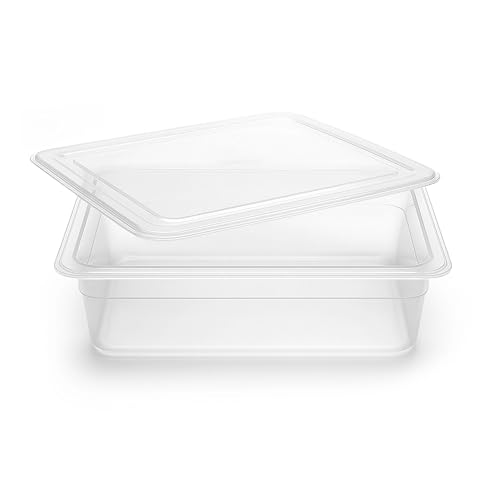
Brod & Taylor Proofing Container, 6 L
$24.95
If you do not already ferment in a graduated container, this $24.95 box will improve your dough more than any mixer will, because it turns bulk fermentation from a guess into a reading you take off the wall of the container.
Check price on AmazonWhere it fits in the rest of the kit
Whether a 4.8 quart bowl is enough depends entirely on your usual batch, and that is a number rather than a feeling. Run your pizza count and diameter through the dough ball weight calculator and the hydration calculator before you decide between this and the larger Halo Pro. Six 12 inch balls at Neapolitan density is a comfortable load here; the same count at 16 inches is not, because dough weight tracks area rather than diameter.
The comparison worth reading before spending $599 is stand mixer versus food processor for dough, which covers what a machine actually contributes and what it does not. If the answer turns out to be a planetary mixer, the KitchenAid Classic is the sensible default and the Bosch Universal Plus is the one that takes batches nothing else here will. All of them sit side by side in the dough mixer roundup, and the cold fermentation guide covers what happens to the dough after the machine has finished with it.
Keep reading
- Best dough mixers for pizza, by tier
- Stand mixer vs food processor for dough
- Dough ball weight calculator
- Ooni Halo Pro review
- Bosch Universal Plus review
- How to make Neapolitan pizza dough
This review draws on published specifications, manufacturer figures and the consensus of verified owner reviews. We have not tested this product ourselves, and we say so rather than implying otherwise. As an Amazon Associate we earn from qualifying purchases.
Frequently asked questions
What is the difference between the Ooni Halo Core and the Halo Pro?
Size, bowl capacity and speed range. Ooni gives the Core as 25 percent smaller and 30 percent lighter than the Pro, at 12.28 inches tall and 23.2 lb, with a 4.8 quart bowl and 20 speed settings. The Pro has a 7.3 quart bowl and 58 speed settings. Both use the same spiral action with a rotating bowl and a removable breaker bar. For a household batch the Core is the sensible one and it saves $200.
How much dough can the Halo Core really mix?
Ooni quotes two up to ten 12 inch dough balls. Ten balls at a typical Neapolitan 250 g is 2.5 kg of dough, which is a great deal for a 4.8 quart bowl, so treat the top of that range as an absolute maximum rather than a comfortable working load. Four to eight balls is where the machine is at its best, and that covers most households.
Do I need to remove the breaker bar?
Only when you switch away from dough. The bar is what stops dough climbing the hook and clumping, so it stays in for kneading. Take it out to fit the silicone edged beater or the dual geared whisk for batters, creams and meringues. That removability is the main practical difference between this and a fixed spiral mixer.
Is a spiral mixer worth it if I already own a KitchenAid?
Probably not, unless your batches are big or your doughs are stiff. A planetary mixer works fine for pizza dough at modest quantities, and after a long cold ferment the difference in the finished pizza is small. Where a spiral mixer earns its keep is repeatability at volume and a lower final dough temperature. If neither of those is a problem you currently have, the money is better spent on the bake.
Will the Halo Core fit under my kitchen cabinets?
Ooni gives its height as 12.28 inches, which clears a standard wall cabinet on most counters. Measure your own gap before ordering, because the number that matters is the clearance above your worktop rather than the machine's height on its own. This is the practical reason to choose the Core over the Pro for a fitted kitchen.
How we choose: we compare published manufacturer specifications, verified owner reviews, and long-established baker's percentage practice. We do not test gear in person. Dough figures are guidance, not a recipe guarantee: flour, water and room conditions all vary, so read your dough as well as the numbers.
Heat safety: a pizza oven at working temperature holds a 700F to 950F floor and a shell hot enough to burn on contact. Use long-handled peels and heat-rated gloves, keep children and pets clear, burn fuel outdoors only with clearance from anything combustible, and never pour water on a hot baking stone. Water flashes to steam instantly and thermal shock cracks stone.
Keeping your own dough and bake numbers? The Dough & Oven Planner is the paid version of these pages: 8 printable worksheets you fill in with your own numbers, plus the full PDF, $29.