The Best Pizza Stones, and When a Steel Beats All of Them
The Unicook 15 inch round cordierite pizza stone at $39.99 is the best pizza stone for most home ovens: cordierite survives the thermal shock that cracks cheap ceramic slabs, and 15 inches fits a standard rack. If your oven tops out at 550F, a quarter inch steel such as the $139 Original Baking Steel will brown a base in 6 to 8 minutes where a stone leaves it pale.
A pizza stone does one job: it holds a large amount of heat and dumps it into the bottom of the dough fast enough to set the base before the top overcooks. Everything that matters about a stone follows from that. Material decides how quickly the heat moves, thickness decides how much is stored, and thermal shock resistance decides whether the thing survives its first winter. Price barely correlates with any of them, which is why the $39.99 pick below beats plenty of stones costing three times as much.
What is a pizza stone actually doing?
A domestic oven cooks mostly with hot air, and air is a terrible conductor. Set a pizza on a wire rack in a 500F oven and the top will be finished long before the base has any colour, because the air simply cannot deliver energy into wet dough quickly enough. A preheated slab changes the mechanism entirely: now the base is in direct contact with a dense, fully charged solid, and it receives a burst of conducted heat in the first thirty seconds. That burst is what produces oven spring, a dry base and the blistering people are chasing.
So the question is never "which stone is best" in the abstract. It is "how much heat can this slab deliver in the first minute, at the temperature my oven can reach". That framing makes the whole category easy to reason about, and it explains why the answer flips depending on whether your oven maxes out at 550F or runs to 900F.
Cordierite is the standard material for a reason. It is a magnesium iron aluminium silicate with an unusually low coefficient of thermal expansion, which is the technical way of saying it can go from cold to 900F without tearing itself apart. The cheap ceramic slabs bundled with entry-level ovens expand more, and that difference is why they develop hairline cracks in a season while cordierite keeps going for years.
The picks, by tier

Unicook 15 inch Round Cordierite Pizza Stone
Cordierite handles thermal shock far better than the ceramic stones that ship free with cheap ovens, which is exactly the failure mode that cracks a stone in its first season.
Best for: Replacing a cracked stone, or a first stone for a home oven.
Check price
Unicook 15 x 15 inch Square Cordierite Pizza Stone
Square covers more of a home oven rack than a round stone of the same nominal size, so it also works for bread, focaccia and Roman al taglio trays.
Best for: Home ovens where the stone doubles as a bread deck.
Check price
Lodge Cast Iron 15 inch Pizza Pan with Silicone Grips
Will not crack, ever, and conducts heat far faster than cordierite. The trade is weight and a longer preheat, plus you have to keep it seasoned.
Best for: Anyone who has already broken a stone and wants to stop buying them.
Check price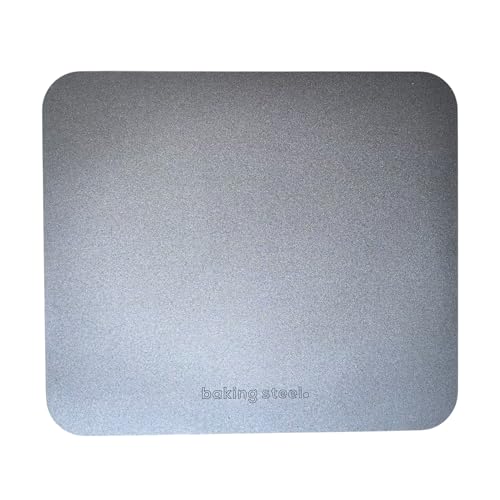
The Original Baking Steel, 14 x 16 x 1/4 inch
Steel moves roughly twenty times more heat per second into the base than cordierite does at the same temperature, which is how a 550F home oven produces a leopard-spotted bottom in six minutes.
Best for: Home oven bakers who cannot raise the temperature and have to raise conductivity instead.
Check pricePrices change often, confirm on Amazon. As an Amazon Associate we earn from qualifying purchases.
How do the four baking surfaces compare?
Preheat figures below are the practical minimum at a domestic oven's maximum setting, measured at the surface rather than by the oven's own thermostat. Prices are the ones on the current listings and change often.
| Surface | Material | Size | Preheat | Price | Can it crack? |
|---|---|---|---|---|---|
| Unicook round | Cordierite | 15 in | 45 to 60 min | $39.99 | Yes, with shock |
| Unicook square | Cordierite | 15 x 15 in | 45 to 60 min | $43.99 | Yes, with shock |
| Lodge pizza pan | Cast iron | 15 in | 50 to 60 min | $49.90 | No |
| ThermiChef steel | Steel, 1/4 in | 16 x 16 in | 45 min | $73.99 | No |
| Original Baking Steel | Steel, 1/4 in | 14 x 16 in | 45 min | $139.00 | No |
Round or square: does the shape matter?
More than people expect, and not for the reason they assume. Nobody's pizza is improved by a round stone being round. What changes is coverage. A 15 inch circle has an area of about 177 square inches. A 15 by 15 inch square has 225, roughly a quarter more usable deck for the same nominal size, and it fills the corners of a rectangular rack where a circle leaves them empty.
That extra deck matters if the stone does more than pizza. The Unicook 15 by 15 inch square stone at $43.99 will take a bread loaf, a focaccia tray or a Roman al taglio pan, and it lets you slide a 14 inch pizza on without the leading edge hanging off. A round stone is tidier, easier to rotate, and slightly less likely to trap a corner against the oven wall where it can overheat unevenly.
One warning that applies to both: leave at least an inch of clearance on every side. A stone that fills the rack blocks the convection path and turns the oven into an unbalanced, bottom-heavy chamber. It also makes the stone far harder to remove safely.
How thick should a pizza stone be?
For cordierite, a little over half an inch is the practical sweet spot, and most 15 inch stones in this price band land between 0.55 and 0.75 inches. Thinner slabs charge faster but discharge just as fast, which shows up as a good first pizza and a mediocre third. Much thicker and the preheat stretches past an hour for a benefit you will rarely use at home.
For steel, the number is a quarter inch and it is close to non-negotiable. Steel plates thinner than that are sold constantly and they store too little energy to justify the weight penalty over a good stone. A quarter inch, 16 by 16 inch plate weighs about 17.6 lb, which is heavy enough that you should check your oven rack is rated for it and heavy enough that you should only move it cold.
Cast iron sits in its own category. The Lodge 15 inch cast iron pizza pan at $49.90 conducts far faster than cordierite and cannot crack, which makes it the correct choice for anyone who has already destroyed two stones. The trades are real: it needs seasoning, it will rust if stored damp, and its raised handles eat into usable deck space.
Who should not buy the Baking Steel?
The Original Baking Steel at $139 is the reference plate in this category and it is the wrong purchase for several kinds of reader. Being blunt about that is the point of a roundup.
Do not buy it if you already own an outdoor pizza oven that runs past 700F. Steel at Neapolitan temperature transfers heat so aggressively that the base carbonises while the rim is still setting, and the fix is to cook on the cordierite floor the oven already has. In that oven the steel is not an upgrade, it is a downgrade you paid $139 for.
Do not buy it if your oven cannot get near its own maximum. Steel's whole advantage is conductivity, and conductivity delivers nothing if the plate never charges. An oven that struggles to hold 450F will produce a mediocre pizza on steel and a mediocre pizza on stone, and the money is better spent on an inspection or a countertop oven.
Do not buy it if you cannot comfortably lift and place a 15 to 17 lb plate in a hot oven, or if your oven racks flex under weight. This is a genuine safety limit, not a soft preference, and it disqualifies more readers than people expect.
Do not buy the $139 version specifically if the $73.99 ThermiChef 16 by 16 inch plate would do. Both are a quarter inch of carbon steel and the physics does not know which logo is on it. You are paying the difference for finish, flatness and a factory seasoning, which are worth something but are not thermal performance. The pizza steel roundup works through that comparison properly.
Who should buy it: home oven bakers stuck at 500F to 550F who want the best base their oven can physically produce and are finished shopping.
How do you preheat and use a stone properly?
Put the cold stone into the cold oven, on the rack position you intend to bake on, then turn the oven to its maximum. Loading a cold slab into a hot oven is the most common way people crack one. Give it 45 to 60 minutes after the oven reaches temperature, not 45 minutes total. An oven typically signals ready in 12 to 15 minutes, and the stone at that moment can be 200F behind the air.
Verify rather than assume. A dual-laser infrared thermometer at $32.99 aimed at the centre of the slab settles the question in two seconds, and the twin lasers mark the edge of the measured spot so you know you are reading the stone and not the element behind it. Once you have measured your own oven a few times you will know its real preheat and can stop checking.
Rack position changes the result more than most people realise. High in the oven puts the pizza close to the top element or the hot ceiling, which browns the cheese and rim faster and suits a thin, fast bake. Lower gives the base more time before the top catches up. If your rims burn while the base is pale, move down. If the base burns first, move up. Timings by style are on the bake time and temperature chart, and the bake temp and time calculator converts between them.
Why do pizza stones crack, and how do you stop it?
Every crack traces back to one of four causes, and all four are avoidable.
Water on hot stone. Never, under any circumstances, including a damp cloth or a splash from the sink. Water flashes to steam inside the pores and the pressure splits the slab. This is also a burn risk, because that steam comes back at your hands.
Cold slab into hot oven. The surface expands, the core does not, and the stone tears along the gradient. Always heat from cold with the oven.
Frozen food on a charged stone. A frozen pizza dropped onto a 550F surface is the same shock in miniature, repeated at one small contact patch. Thaw first, or use a screen.
Damp storage. A stone left outdoors through a wet winter absorbs water it will not shed, and the first firing next season turns that water into steam inside the slab. Store stones dry and cover any oven left outside. The full walkthrough of cleaning and seasoning is in the stone care guide.
Handling a hot stone: do not lift a stone out of a hot oven. Let it cool inside, with the door shut for the first stage, then ajar. If you must move one hot, use rated contact-heat gloves and a peel underneath it, never a folded towel. A dropped stone at 550F breaks, and the pieces stay dangerous for a long time.
What should you launch onto the stone with?
Half the complaints about stones are actually launch failures. A pizza that folds on the way in leaves a mess, and the cook blames the surface. Build on a wooden surface, because wood releases raw dough far more reliably than bare metal does, and dust the peel with a coarse flour rather than a fine one.
The Ooni 14 inch bamboo peel at $44.98 is the standard prep surface and doubles as a serving board. Dust it with semola rimacinata , which rolls under the dough like tiny ball bearings instead of hydrating into paste the way 00 flour does. If you are still learning, perforated aluminium pizza screens at $27.99 for five remove the launch from the equation completely: build on the screen, slide the whole thing onto the stone, then pull the screen at the two minute mark once the base has set.
The rest of the technique, including the shake test and the two-second commitment rule, is in the launch guide, with the failure modes mapped on the launch troubleshooting chart.
Does the dough matter more than the stone?
Usually, yes. A stone fixes a pale, soggy base. It cannot fix a dense one. If your crust is tight, tough or refuses to open into an airy rim, the problem is upstream of the oven: too little hydration, too little fermentation, or a ball weight wrong for the diameter you are stretching to.
Start at 62 to 65 percent hydration for a home oven bake on stone or steel, 2.5 percent salt, and 0.05 to 0.2 percent instant yeast if you are cold fermenting for 24 to 72 hours. Run those through the hydration calculator and the ball weight calculator, and read baker's percentage explained if the numbers are new to you. Then clean the stone with a brass brush and scraper at $11.99 and go again.
A full review of the square stone
The Unicook 15 inch square stone review goes further into the thickness, the 1,450F rating and the two ways owners actually break a cordierite stone. It is also straight about the limit: if your complaint is a pale base rather than a general lack of a baking surface, that is a conduction problem, and the ThermiChef steel review covers the material that fixes it.
Frequently asked questions
What is the best pizza stone for a home oven?
The Unicook 15 inch round cordierite stone at $39.99 is the right first stone for almost every domestic oven. Cordierite tolerates thermal shock far better than the plain ceramic slabs bundled with cheap ovens, which is the exact failure that cracks a stone in its first season. Fifteen inches covers a standard rack without blocking airflow at the edges, and the price is low enough that replacing it in five years is not painful.
Is a pizza steel better than a pizza stone?
For a home oven capped at 550F, yes, clearly. Steel moves roughly twenty times more heat per second into the base of the pizza than cordierite does at the same temperature, so it browns and blisters a base in six to eight minutes where a stone leaves it pale. In a 900F outdoor oven the advantage disappears and can invert, because steel that hot scorches a Neapolitan base before the rim sets.
How long should you preheat a pizza stone?
Between 45 and 60 minutes at your oven's maximum setting for a half inch cordierite stone, and closer to 45 for a quarter inch steel. The oven's ready chime is about the air, not the slab, and the slab is what cooks the pizza. Verify with an infrared thermometer aimed at the centre of the surface rather than trusting time. Most disappointing home pizza is a stone that went in cold at 20 minutes.
Why did my pizza stone crack?
Thermal shock, almost always. Water on a hot stone, a cold stone thrown into a hot oven, a frozen pizza dropped onto a fully charged surface, or a stone stored damp over winter and then fired. Cordierite resists this better than ceramic but nothing is immune. Heat the stone with the oven from cold, never wash it with water, and let it cool inside the oven rather than lifting it out onto a cold counter.
How do you clean a pizza stone without ruining it?
Burn it clean, then brush it. Run the oven hot for 30 minutes so baked-on cheese and sugar carbonise, let it cool enough to work safely, then take a stiff brass brush and a scraper to the surface. Never use soap, never soak it, and never put it in a dishwasher. A stone is porous, it will drink detergent, and the next pizza will taste of it. Dark staining is permanent and completely harmless.
Do I need a stone if my pizza oven already has one?
Not at first, but keep the replacement in mind. Budget outdoor ovens ship with thin stones that crack or crumble sooner than the oven itself does, and a replacement is usually a $40 fix rather than a new oven. Measure your oven's floor opening before ordering, because a stone even slightly oversized will not seat flat and a stone too small leaves gaps that heat and debris fall through.
How we choose: we compare published manufacturer specifications, verified owner reviews, and long-established baker's percentage practice. We do not test gear in person. Dough figures are guidance, not a recipe guarantee: flour, water and room conditions all vary, so read your dough as well as the numbers.
Heat safety: a pizza oven at working temperature holds a 700F to 950F floor and a shell hot enough to burn on contact. Use long-handled peels and heat-rated gloves, keep children and pets clear, burn fuel outdoors only with clearance from anything combustible, and never pour water on a hot baking stone. Water flashes to steam instantly and thermal shock cracks stone.
Keeping your own dough and bake numbers? The Dough & Oven Planner is the paid version of these pages: 8 printable worksheets you fill in with your own numbers, plus the full PDF, $29.