The Best Pizza Steels for a 550F Home Oven
The ThermiChef 16 by 16 inch pizza steel at $73.99 is the best value plate for a home oven: a full quarter inch and about 17.6 lb of mass, which is the specification that matters. Steel conducts heat into a pizza base roughly twenty times faster than cordierite, so a 550F oven produces a browned, blistered bottom in 6 to 8 minutes instead of a pale one.
A pizza steel exists to solve one specific problem: your oven will not get hot enough. A domestic oven caps out somewhere between 500F and 550F, and a Neapolitan pizzeria works at 850F to 950F. You cannot close that gap with temperature, so you close it with conductivity instead. Steel delivers heat into the base of a pizza far faster than stone does at the same temperature, which buys back most of what the missing 350F would have given you. That is the entire pitch, and it is a good one.
What does a steel do that a stone cannot?
Think about what happens in the first thirty seconds after a pizza lands. The base is wet dough at room temperature, roughly 70F. It is sitting on a solid at 550F. Heat flows from the solid into the dough, and how fast it flows depends on the material's thermal conductivity and how much stored energy sits immediately beneath the contact patch.
Cordierite is a good insulator by ceramic standards, which is exactly why it survives thermal shock, and a mediocre conductor for the same reason. Carbon steel is the opposite: it moves energy through itself very quickly, so the moment the cold dough draws heat out of the surface, more heat arrives from the mass underneath. The practical figure people quote is that steel transfers roughly twenty times more heat per second into the base at the same surface temperature. That is the difference between a base that browns in six minutes and one that is still pale at ten.
The second, less-discussed advantage is recovery. Because steel conducts internally as well as at the surface, the cold patch left by a pizza refills from the surrounding plate within a couple of minutes. A cordierite stone has a much slower internal transfer, which is why the third pizza off a stone is often visibly worse than the first. If you cook several pizzas in a row, this is the benefit you will actually notice.
There is a cost. Steel's aggressiveness is not adjustable. In a 900F oven the same property that rescues a 550F bake carbonises a Neapolitan base in under a minute. Steel belongs in the oven that is too cool, never in the oven that is already hot enough.
The picks, by tier

Unicook 15 inch Round Cordierite Pizza Stone
Cordierite handles thermal shock far better than the ceramic stones that ship free with cheap ovens, which is exactly the failure mode that cracks a stone in its first season.
Best for: Replacing a cracked stone, or a first stone for a home oven.
Check price
ThermiChef 16 x 16 inch Pizza Steel, 1/4 inch
A full quarter inch and 17.6 lb of mass at roughly half the price of the name-brand plate. Thickness is the spec that matters here and this one does not cut it.
Best for: Getting real steel performance without paying $139.
Check price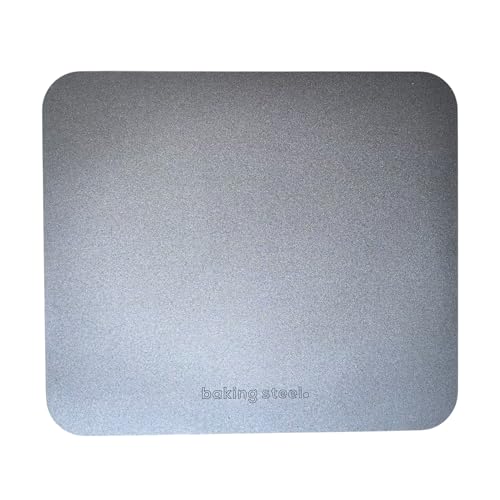
The Original Baking Steel, 14 x 16 x 1/4 inch
Steel moves roughly twenty times more heat per second into the base than cordierite does at the same temperature, which is how a 550F home oven produces a leopard-spotted bottom in six minutes.
Best for: Home oven bakers who cannot raise the temperature and have to raise conductivity instead.
Check pricePrices change often, confirm on Amazon. As an Amazon Associate we earn from qualifying purchases.
How do the baking surfaces compare on paper?
Bake times below are for a 12 inch pizza at a domestic oven's maximum, roughly 550F, after a full preheat. Weights are approximate for the sizes listed.
| Surface | Thickness | Weight | Preheat | Bake at 550F | Price |
|---|---|---|---|---|---|
| Unicook cordierite round | 0.6 in | 7 lb | 60 min | 9 to 11 min | $39.99 |
| Lodge cast iron pan | 0.2 in | 9 lb | 55 min | 7 to 9 min | $49.90 |
| ThermiChef steel | 0.25 in | 17.6 lb | 45 min | 6 to 8 min | $73.99 |
| Original Baking Steel | 0.25 in | 15 lb | 45 min | 6 to 8 min | $139.00 |
Why is thickness the only specification that matters?
Because every carbon steel plate has essentially the same thermal conductivity. Brand does not change the physics. What changes between plates is how much steel is there, and that is thickness multiplied by area.
A quarter inch is the accepted minimum because it stores enough energy to bake two or three pizzas in succession without a meaningful drop. Plates at an eighth of an inch cool too fast: the first pizza is excellent, the second is ordinary, and you have carried 9 lb of metal for the privilege. Half inch plates store more still, but the preheat pushes past 75 minutes, the weight goes above 30 lb for a full-size plate, and most domestic oven racks are not rated for that.
Area matters second. A 16 by 16 inch plate covers more of a rack than a 14 by 16, which gives you room to land a slightly off-target launch and space to bake bread on. Measure your oven interior and subtract at least an inch on each side so hot air can still circulate around the plate. A steel that fills the cavity edge to edge blocks convection and produces an oven that is fierce underneath and cold above.
Who should not buy the $139 Baking Steel?
The Original Baking Steel is a genuinely excellent, flat, pre-seasoned plate and it is not the right purchase for most people reading this. Here is who should walk away from it.
Do not buy it if the $73.99 ThermiChef plate would serve. Both are a quarter inch of carbon steel. The dough cannot read the label. You are paying the $65 difference for edge finish, flatness tolerance and factory seasoning, which are real but are conveniences rather than performance. If you would rather put that $65 into better flour and a proper peel , you would be making the better pizza decision.
Do not buy any steel if you own an outdoor pizza oven running past 700F. This is the single most common wasted purchase in the category. Your oven already has a cordierite floor sized and specified for its heat. Adding steel to it produces black bases and nothing else.
Do not buy a steel if your oven cannot reliably hold its own maximum. Conductivity delivers nothing if the plate never charges. If your oven runs 50F cold, calibrate or repair it first, because that is a free fix and this is a $139 one.
Do not buy one if lifting 15 to 18 lb into a hot oven at chest height is not something you want to do. That is a genuine handling limit and it is not worth an injury. A cordierite stone at 7 lb makes far more sense, and a cast iron pizza pan at $49.90 sits between the two with handles moulded in.
Do not buy one if your complaint is a tough, dense crust. Steel fixes pale bases. It does not fix under-fermented dough, and no amount of bottom heat will open a rim that has no gas in it. Fix hydration and fermentation first using the hydration calculator and the cold fermentation guide.
Who should buy it: home bakers permanently capped at 550F who want the best base their oven can physically produce, who bake bread as well as pizza, and who want the finished, seasoned version and are done shopping the category.
How do you actually use a steel for the best base?
Position it high. Counterintuitively, a steel usually works best on the second rack from the top rather than the middle. The plate handles the base without help, so what you want from the rest of the oven is aggressive top heat to finish the cheese and rim in the same six to eight minutes. Putting the pizza close to the ceiling delivers that.
Preheat from cold and preheat long. Load the plate into a cold oven, set maximum, and start counting 45 minutes from the moment the oven says it is ready, not from when you turned it on. An infrared thermometer at $32.99 settles it: aim at the centre of the plate, and if it reads under 500F, wait.
Consider a broiler finish. Once the pizza is in, switching the top element to broil for the final 60 to 90 seconds pushes ceiling temperature up sharply and produces the rim colour that a 550F bake otherwise cannot. Watch it continuously, because the window between excellent and burnt at that setting is short. Timings by style are on the bake time and temperature chart.
Give the plate two minutes between pizzas. Steel recovers fast, but not instantly, and the difference between launching immediately and waiting 120 seconds is visible on the base.
Handling: never move a hot steel. It holds enough energy to cause a serious burn long after the oven is off, and it does not look hot. Let it cool inside the oven. If you must handle one warm, use contact-heat rated gloves such as the Grill Armor EN407 gloves , not fabric mitts, and keep the path to where you are setting it down completely clear first.
How do you season a steel and keep it from rusting?
Treat it exactly like cast iron. Wash a new, unseasoned plate once with hot water and a little detergent to remove mill oil, dry it immediately and thoroughly, then wipe on the thinnest possible film of a high smoke point oil. Bake it upside down at 450F to 500F for an hour and let it cool in the oven. Repeat twice if you want a hard, dark finish.
After that, do not wash it again. Scrape residue off with a bench scraper while the plate is warm, wipe with a dry cloth, and put it away dry. If baked-on cheese is stubborn, run the oven hot for 20 minutes and the residue carbonises into something that brushes off. Surface rust from a damp cupboard is not a disaster: steel wool, wipe, re-oil, re-bake.
Many people leave the steel in the oven permanently, on a low rack, and simply cook around it. It stabilises oven temperature, it is never in the way of a preheat, and it never gets stored damp. The only cost is a slightly longer warm-up for everything else you bake.
Do you still need a peel with a steel?
Yes, and arguably more than with an outdoor oven, because you are working through a door at chest height with a hot plate a foot inside. Build on a wooden surface such as the Ooni 14 inch bamboo peel at $44.98, dust with coarse semolina rather than fine flour, and launch in one committed motion.
If launching is still the weak link, pizza screens at $27.99 for five work well on steel: build on the screen, set it on the plate, and pull the screen out at the two minute mark once the base has set. You lose a small amount of crispness at the contact points and you stop losing whole pizzas. The technique is covered in the launch guide and the failure modes on the launch troubleshooting chart.
If you are weighing a steel against buying a dedicated oven instead, the pizza oven roundup and the buying guide lay out what the extra 350F actually buys you, and the pizza stone roundup covers the cordierite side of the same decision.
Full reviews of the steels in this roundup
Both steels have their own review. The Original Baking Steel review covers what $139 buys, how to preheat a plate properly and why it will never produce Neapolitan pizza in a domestic oven. The ThermiChef 16 inch pizza steel review covers the larger, cheaper plate you season yourself, and works through the quarter inch against three eighths decision, which is the only specification on a steel that changes the cooking.
Frequently asked questions
Is a pizza steel worth it?
In a home oven that stops at 500F to 550F, a quarter inch steel is the highest-value upgrade available. Steel conducts heat into the base of a pizza roughly twenty times faster than cordierite at the same temperature, which converts a pale, slightly soggy base into a browned, blistered one in the same 6 to 8 minute bake. In an outdoor oven running past 700F it is unnecessary and can scorch the base.
How thick should a pizza steel be?
A quarter inch, and treat that as a floor rather than a target. Thinner plates are sold widely and store too little energy to beat a good cordierite stone, so you carry the weight without getting the benefit. A quarter inch 16 by 16 inch plate weighs about 17.6 lb. Half inch plates exist, store more heat and preheat far longer, and are usually more weight than a domestic oven rack should carry.
How do you preheat a pizza steel?
Put the steel into a cold oven on the rack you will bake on, set the oven to maximum, and give it at least 45 minutes after the oven itself signals ready. Steel conducts fast but it still has to absorb a large amount of energy, and the oven reaches temperature long before the plate does. Confirm with an infrared thermometer aimed at the middle of the plate rather than trusting the timer.
Will a pizza steel rust?
Yes, it is carbon steel and it rusts if stored damp or washed and left wet. The management is the same as cast iron: wipe rather than wash, dry it immediately and completely, and keep a thin film of high smoke point oil on the surface. Surface rust is cosmetic and scrubs off with steel wool followed by a re-oil and a bake. Never put a steel through a dishwasher.
Can you use a pizza steel on a grill or in an outdoor oven?
On a covered gas grill, yes, and it works well because a grill has plenty of bottom heat and no radiant top. Inside a 900F outdoor pizza oven, do not. Steel at Neapolitan temperature dumps heat into the base so fast that the bottom carbonises before the rim has set, and you end up with a black base under an undercooked pizza. Use the oven's own cordierite floor there.
Steel or stone for a beginner?
Steel, if your ceiling is 550F and your budget reaches $74. It is more forgiving in one specific way that matters early on: it recovers quickly between pizzas, so a second and third pie bake almost as well as the first. The one thing a stone does better for a beginner is tolerate abuse, since it does not rust, and a $39.99 cordierite round is a low-risk place to start.
How we choose: we compare published manufacturer specifications, verified owner reviews, and long-established baker's percentage practice. We do not test gear in person. Dough figures are guidance, not a recipe guarantee: flour, water and room conditions all vary, so read your dough as well as the numbers.
Heat safety: a pizza oven at working temperature holds a 700F to 950F floor and a shell hot enough to burn on contact. Use long-handled peels and heat-rated gloves, keep children and pets clear, burn fuel outdoors only with clearance from anything combustible, and never pour water on a hot baking stone. Water flashes to steam instantly and thermal shock cracks stone.
Keeping your own dough and bake numbers? The Dough & Oven Planner is the paid version of these pages: 8 printable worksheets you fill in with your own numbers, plus the full PDF, $29.