Baking Steel Review: The Best $139 in Home Pizza
A quarter inch slab of solid steel moves heat into a pizza base far faster than cordierite can, and in a 550F domestic oven it produces genuinely excellent New York style pizza in six to eight minutes for $139. Buy it if you are cooking in the oven you already own and want the biggest single improvement available. Skip it if what you want is Neapolitan pizza, because a 90 second bake with a puffed and blistered rim needs a 900F floor and no domestic oven gets remotely close, steel or not.
It will transform the pizza from your kitchen oven, and it cannot make Neapolitan pizza.
Specifications
| Dimensions | 14 x 16 x 1/4 in |
|---|---|
| Material | Solid low carbon steel |
| Finish | Pre-seasoned by hand before shipping |
| Manufacture | Made in the USA, in Massachusetts, since 2012 |
| Manufacturer heat claim | Stated as 18 times faster heat transfer than a pizza stone |
| Use | Any oven, any grill |
| Durability | Stated crack proof, with owners still using 2013 units |
| Listed price | $139.00 |
Specifications above come from Baking Steel's published product specifications. Treat pricing as approximate, since Amazon pricing moves.
What it does well
- Conduction into the base is what browns a crust, and steel moves far more heat per second into dough than cordierite does. That is the entire product and it works.
- It cannot crack. A cordierite stone dies of thermal shock eventually; a steel plate has no such failure mode, which is why fifteen year old units are still in service.
- It ships pre-seasoned, so the first pizza can happen the day the box arrives rather than after an hour of oiling and baking.
- It is not only a pizza tool. Sourdough, English muffins, smash burgers and seared steak all work on it, which spreads the $139 across a lot of cooking.
- It works on a grill as well as in an oven, which is a genuine route to a hotter floor than a domestic oven can provide.
Where it falls short
- It cannot make Neapolitan pizza and nothing will change that. A 60 to 90 second bake needs a floor near 900F and a domestic oven tops out around 550F.
- At 14 by 16 inches the largest pizza it will comfortably take is about 13 inches, once you allow an edge to land on.
- It is heavy, and a quarter inch plate of this size is an awkward thing to lift in and out of a hot oven. Most owners simply leave it in permanently.
- It is bare steel, so it will rust if it is stored damp. Dry it on the hob or in a cooling oven, not on a draining board.
- $139 is a real price for a piece of steel, and thicker, larger steels from other makers cost less. What you are paying for here is the seasoning, the finish and the origin.
What owners report
Owner reports on the Baking Steel are unusually consistent for a product this old, and the consensus is that it does exactly what it claims for pizza in a home oven and that it lasts effectively forever. The recurring practical tip in those reports is about preheating rather than the steel itself: an hour at full temperature, on a rack in the upper third of the oven, then a few minutes under the broiler immediately before launching to drive the surface temperature up further.
The recurring disappointment, and it is worth naming plainly, comes from people who expected Neapolitan results. A steel in a 550F oven makes superb New York style pizza and it does not make a 90 second Neapolitan pizza, because the floor temperature is not there. Our home oven steel versus outdoor pizza oven comparison sets out exactly what the extra 350F buys, and the oven temperature by pizza style chart maps which styles are reachable at which floor temperatures.
Who it suits
- Anyone making pizza in a domestic oven who has not yet replaced the rack with a proper baking surface.
- New York, Detroit, Sicilian and pan pizza makers, all of which are baked in domestic oven territory.
- Bread bakers, since the same conduction that browns a pizza base gives a loaf its oven spring.
- People who do not want to own an outdoor oven, or cannot, and want the best pizza reachable indoors.
Who should skip it
- Anyone whose goal is Neapolitan pizza with a leoparded rim. That needs an oven, not a surface.
- People who already own an outdoor oven with a decent stone floor, where the steel adds nothing.
- Anyone who wants a 16 inch pizza, since 14 by 16 inches caps you around 13.
- Buyers on a tight budget, who can get a thicker and larger steel for less money if they are willing to season it themselves.
Alternatives worth considering

ThermiChef 16 x 16 in Pizza Steel, 1/4 in, 17.6 lb
$73.99
Two more inches in each direction at the same quarter inch thickness for roughly half the price. It ships shot-blasted rather than pre-seasoned, so you season it yourself before the first bake, and you must check your oven depth takes 16 inches.
Check price on Amazon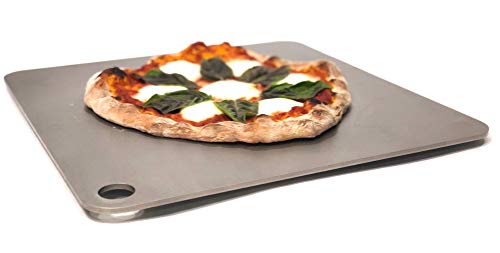
ThermiChef 16 x 16 in Pizza Steel, 3/8 in, 27.5 lb
$101.99
Half again as thick, which is the specification that actually matters. A 3/8 inch plate stores more heat and recovers faster between pizzas, which is what you want if you are cooking four in a row rather than one.
Check price on Amazon
Unicook 15 x 15 in Square Cordierite Pizza Stone, 8 lb
$45.99
A third of the price and a genuinely different tool. Cordierite conducts far less heat than steel so the base browns more gently, which some people prefer for bread and for longer bakes. It can crack from thermal shock, which steel cannot.
Check price on AmazonWhere it fits in the rest of the kit
The honest way to decide between a steel and an oven is to decide which pizza you want. A steel at 550F makes excellent New York style pizza in six to eight minutes and it cannot make Neapolitan pizza, because a 90 second bake needs a floor near 900F. Our home oven steel versus outdoor pizza oven comparison lays out exactly what that 350F is worth, and the oven temperature by pizza style chart maps which styles are reachable at which floor temperatures.
If you are choosing the surface rather than the oven, pizza stone versus pizza steel covers the material and cast iron pan versus baking steel covers the cheap alternative most people already own. The ThermiChef 16 inch steel is the larger and cheaper option if you will season it yourself, and the Unicook square stone is the cordierite route at a third of the price. Once the steel is in, the bake temperature and time calculator and the New York style dough guide are what turn it into a pizza.
Keep reading
- Pizza stone vs pizza steel
- Home oven steel vs outdoor pizza oven
- Best pizza steels, by tier
- Bake temperature and time calculator
- ThermiChef 16 inch pizza steel review
- New York style pizza dough
This review draws on published specifications, manufacturer figures and the consensus of verified owner reviews. We have not tested this product ourselves, and we say so rather than implying otherwise. As an Amazon Associate we earn from qualifying purchases.
Frequently asked questions
Is a baking steel better than a pizza stone?
For pizza in a home oven, yes, clearly. Steel conducts heat into the dough far faster than cordierite, and conduction into the base is what browns a crust. That is why a 550F oven with a steel outperforms the same oven with a stone. Cordierite is cheaper, lighter and gentler, which suits some breads, and it can crack from thermal shock, which steel cannot. For a pizza base specifically, steel wins.
Can you make Neapolitan pizza on a baking steel?
No, and this is the most important thing to understand before buying. True Neapolitan pizza bakes in 60 to 90 seconds on a floor near 900F, and a domestic oven reaches around 550F. A steel will give you the best base that temperature can produce, which is excellent New York style pizza in six to eight minutes, and it will never give you a 90 second bake with a puffed leoparded rim. That takes an oven.
How do you preheat a baking steel?
Give it an hour at your oven's maximum temperature, on a rack in the upper third of the oven. Steel takes far longer to come up to temperature than the air around it, so an oven that beeps ready after ten minutes is nowhere near ready. Many owners then run the broiler for five minutes immediately before launching, which drives the surface temperature up and heats the roof of the oven so the top of the pizza keeps pace with the base.
Will a baking steel rust?
It will if you store it damp, because it is bare low carbon steel with a seasoned surface rather than a coating. Wipe it while warm, never soak it, and if you wash it, dry it on the hob or in a cooling oven rather than on a rack. The simplest answer, and what most owners do, is to leave it in the oven permanently on a low rack and cook around it, which means it never gets stored wet at all.
Baking Steel or a cheaper 16 inch steel?
The cheaper steels are the same material and often bigger. What $139 buys you here is a hand seasoning before shipping, a well finished plate and a US manufacturer that has been doing this since 2012. A ThermiChef 16 by 16 at $73.99 gives you more cooking area for less money in exchange for seasoning it yourself. If you want the most heat capacity per dollar, look at the 3/8 inch versions rather than a larger quarter inch one.
How we choose: we compare published manufacturer specifications, verified owner reviews, and long-established baker's percentage practice. We do not test gear in person. Dough figures are guidance, not a recipe guarantee: flour, water and room conditions all vary, so read your dough as well as the numbers.
Heat safety: a pizza oven at working temperature holds a 700F to 950F floor and a shell hot enough to burn on contact. Use long-handled peels and heat-rated gloves, keep children and pets clear, burn fuel outdoors only with clearance from anything combustible, and never pour water on a hot baking stone. Water flashes to steam instantly and thermal shock cracks stone.
Keeping your own dough and bake numbers? The Dough & Oven Planner is the paid version of these pages: 8 printable worksheets you fill in with your own numbers, plus the full PDF, $29.