Cuisinart Pro Custom 11 Review: Pizza Dough in 45 Seconds
With the supplied dough blade the Pro Custom 11 brings a pizza dough together in around 45 seconds, which no stand mixer can match, and at $199.95 it is half the price of the cheapest mixer here. Buy it if you want same day dough fast and a machine that also does everything else a processor does. Skip it if you ferment cold for two or three days and care about hitting a final dough temperature, because the blade puts real heat into the dough in that minute and heat is what drives fermentation speed.
The fastest route from flour to dough, and the one thing you have to watch while it happens.
Specifications
| Capacity | 11 cups |
|---|---|
| Motor | 625 W |
| Feed tube | Extra large, stated to take whole fruits and vegetables |
| Controls | On, off and pulse |
| In the box | Chopping, mixing and dough blade, medium shredding disc, 4 mm medium slicing disc, detachable disc stem, spatula, small and large pushers |
| Warranty | 5 year motor, 3 year limited |
| Materials | BPA free |
| Listed price | $199.95 |
Specifications above come from Cuisinart's published specifications for the Pro Custom 11. Treat pricing as approximate, since Amazon pricing moves.
What it does well
- It is genuinely fast. A pizza dough comes together in roughly 45 seconds, against 8 to 12 minutes in a stand mixer.
- The dough blade is included rather than sold separately, which is not universal at this price.
- It is the most useful machine in a small kitchen. Slicing, shredding and chopping all get used far more often than a dough hook.
- Pulse control lets you bring a shaggy dough together in stages rather than committing to a continuous run.
- A 5 year motor warranty on a 625 W platform, which is a reasonable indication of how the manufacturer expects it to be worked.
Where it falls short
- It heats the dough. Forty five seconds of a blade at speed puts in real friction, and a dough that comes out at 80F rather than 75F ferments considerably faster than your recipe expects.
- You cannot watch gluten develop. In a mixer you stop when the dough looks right; in a processor the lid is on and the dough is a blur.
- Very wet doughs climb the blade. Above about 70 percent hydration a processor becomes an awkward tool and most people mix by hand with folds instead.
- Batch size is limited by the bowl, and an 11 cup bowl full of dough is a much smaller batch than 11 cups of vegetables.
- It is loud, in the way every food processor is loud.
What owners report
Owner reports on using this class of processor for dough are consistent and fairly technical, which is unusual. The people who like it for pizza describe the same workflow every time: iced water, pulse to bring it together, stop the moment a ball forms, then finish with a short rest and a fold or two on the bench. The people who are disappointed almost always describe running it too long and ending up with a warm, tight dough.
That gap is the whole story with this machine. It is a fast tool that punishes inattention, whereas a stand mixer is a slow tool that forgives it. If you are going to work to a schedule, take the finished dough temperature and feed it into the proof time calculator rather than trusting the clock, and read the stand mixer versus food processor comparison for the full side by side.
Who it suits
- Anyone making same day dough on a weeknight, where 45 seconds against 12 minutes is the point.
- Small kitchens where one machine has to justify its counter space across many jobs.
- People who already own a good oven and a baking surface and do not want to spend $400 on a mixer.
- Cooks who will actually use the slicing and shredding discs, which is where the value really sits.
Who should skip it
- Anyone running a 48 or 72 hour cold ferment who wants final dough temperature to land within a degree.
- People working above about 70 percent hydration, where the dough climbs the blade.
- Bulk bakers, since bowl volume caps the batch hard.
- Anyone who wants to watch dough develop and stop by feel rather than by count.
Alternatives worth considering

KitchenAid Classic Series 4.5 Quart Tilt-Head Stand Mixer K45SS
$399.00
Twice the price and twelve times the mixing time, and in exchange the dough comes out close to the temperature it went in and you can watch it develop. For long fermented dough that control is worth paying for.
Check price on Amazon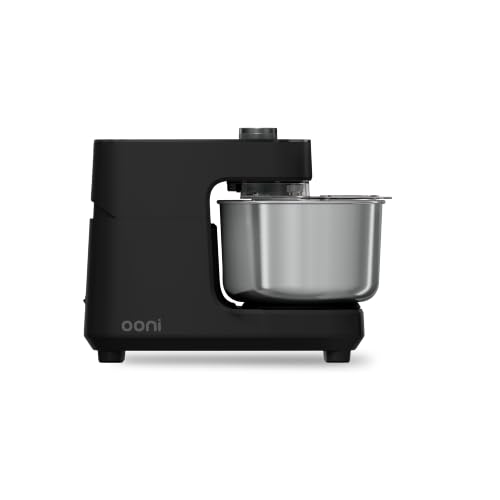
Ooni Halo Core Spiral Dough Mixer, 4.8 Quart
$599.00
A spiral action built for exactly one job, with the lowest friction and therefore the coolest finished dough of anything here. It does nothing a processor does, so this is only the right answer if dough is the priority.
Check price on Amazon
Etekcity 0.1 g Food Kitchen Scale with Bowl
$18.99
Before any mixing machine. Volume measures of flour vary by up to 20 percent depending on how the cup was filled, which is enough to move a dough from 65 percent hydration to 55 without you noticing, and no machine can fix a formula that was wrong before it started.
Check price on AmazonWhere it fits in the rest of the kit
The one number to take seriously with a processor is final dough temperature, because that is what the blade changes. Measure it as the dough comes out, then feed it into the proof time calculator rather than following the clock in a recipe. A dough finishing at 80F instead of 75F will be ready considerably sooner than the recipe expects, and the fermentation time by temperature chart shows how steeply that curve moves.
If that sounds like more management than you want, the alternative is a mixer that does not heat the dough in the first place. We set the two approaches against each other in stand mixer versus food processor for dough, and the KitchenAid Classic review covers the obvious step up at $399. The dough mixer roundup has the whole field, and the hydration calculator gets the formula right before any machine touches it, which is the part that actually decides the dough.
Keep reading
- Stand mixer vs food processor for dough
- Best dough mixers for pizza, by tier
- Proof time calculator
- KitchenAid Classic K45SS review
- Cold fermentation guide
- Baker's percentage explained
This review draws on published specifications, manufacturer figures and the consensus of verified owner reviews. We have not tested this product ourselves, and we say so rather than implying otherwise. As an Amazon Associate we earn from qualifying purchases.
Frequently asked questions
Can you make pizza dough in a food processor?
Yes, and quickly. With a dough blade a pizza dough comes together in around 45 seconds, and the result is perfectly good for a same day bake. The technique that matters is temperature control: use cold or iced water, pulse rather than running continuously, and stop the instant a ball forms. The dough will not look like mixer dough at that point, and it does not need to, because a short bench rest and a couple of folds will finish it.
Does a food processor overheat pizza dough?
It raises the temperature noticeably, yes. Blade friction over 45 seconds puts in real heat, and a dough finishing at 80F rather than 75F will ferment considerably faster than a recipe written for the lower figure. That is not a fault, it is physics, and it is manageable. Use iced water, keep the run short, and take the finished dough temperature with a probe if you are working to a fermentation schedule.
Which blade do I use for pizza dough?
The dough blade supplied in the box, which is the blunt plastic one rather than the sharp steel chopping blade. The blunt profile pushes and folds the dough rather than cutting it, which is what develops gluten. Using the sharp blade will still produce something dough shaped, but it cuts the strands as fast as they form and the finished dough is noticeably weaker.
How much dough will an 11 cup processor make?
Roughly two to four 250 g dough balls, depending on hydration. The bowl volume is the hard limit and dough takes up far more of it than the equivalent weight of vegetables, so an 11 cup rating does not translate into 11 cups of dough. If you need six or more balls at a time, a stand mixer or a larger machine is the better tool.
Food processor or stand mixer for pizza dough?
The processor if speed and price decide it, the mixer if control does. A processor is four times faster and half the price. A mixer lets you add water gradually, watch the gluten develop and finish close to the temperature you started at, which matters most for long cold fermented dough. Many people who make pizza seriously own both and use the processor on weeknights.
How we choose: we compare published manufacturer specifications, verified owner reviews, and long-established baker's percentage practice. We do not test gear in person. Dough figures are guidance, not a recipe guarantee: flour, water and room conditions all vary, so read your dough as well as the numbers.
Heat safety: a pizza oven at working temperature holds a 700F to 950F floor and a shell hot enough to burn on contact. Use long-handled peels and heat-rated gloves, keep children and pets clear, burn fuel outdoors only with clearance from anything combustible, and never pour water on a hot baking stone. Water flashes to steam instantly and thermal shock cracks stone.
Keeping your own dough and bake numbers? The Dough & Oven Planner is the paid version of these pages: 8 printable worksheets you fill in with your own numbers, plus the full PDF, $29.