The Best Gas Pizza Ovens, From $148 to a $999 Outdoor Kitchen Build
The Solo Stove Pi Prime at $399.99 is the best gas pizza oven for most people: a demi-dome chamber built purely around propane, with no fuel swapping and no fire to tend. Budget about 20 to 30 minutes of preheat, and expect roughly ten to twenty hours of cooking from a standard 20 lb propane tank.
Gas is the correct default for a first pizza oven, and the reason is boring and decisive: it turns on. You set the dial, wait 20 to 30 minutes, and the oven holds temperature for as long as the tank lasts. There is no fire to build, nothing to feed every three minutes, and no session that fails because the wood was damp. At Neapolitan speeds the finished pizza is far closer to a wood-fired one than anyone selling wood ovens likes to admit, because a 90 second bake is much too fast to pick up meaningful smoke.
Why does chamber shape matter more than burner size?
Every gas pizza oven has more than enough burner. What separates them is what the chamber does with the heat once it is there.
Hot gas rises and then looks for the exit, which in a pizza oven is the mouth. A shallow, boxy chamber lets a large share of that energy walk straight out of the opening, so the burner has to work continuously to replace it and the front of the stone stays noticeably cooler than the back. A demi-dome or arched chamber, which is what the Solo Stove Pi Prime and the Gozney Arc designs use, curves the gas back down onto the stone before it reaches the mouth. You get a hotter floor for the same fuel and a smaller front-to-back temperature spread.
Burner geometry matters second. A single point burner at the back creates one very hot spot, which is why small ovens scorch the far edge of a pizza. The Ooni Koda 16 uses an L-shaped burner running across the back and partway up one side instead, which spreads the flame front and is the main reason it burns the rear rim less aggressively than smaller ovens do.
Insulation matters third, and only starts to show up across a long session. That is the argument for the heavier ovens, and it is a genuine one if you cook for a crowd. It is irrelevant if you make three pizzas and stop.
The picks, by tier

Cuisinart CPO-401 Outdoor Pizza Oven
Propane, a stone floor and a peel for under $150. It will not hold temperature across six pizzas, but it reaches the temperature that matters and costs a third of the alternatives.
Best for: A first gas oven for occasional weekend baking.
Check price
Solo Stove Pi Prime Gas Pizza Oven
A demi-dome chamber and a wide mouth built purely around propane. No fuel swapping, no fire management, and a shape that pushes heat back down onto the stone rather than out of the opening.
Best for: Gas-only cooks who never intend to burn wood.
Check price
Gozney Arc Lite Propane Outdoor Pizza Oven
The Arc chamber shape at a lower price and lighter weight than the XL, which trades some heat retention across back-to-back bakes for a genuinely portable oven.
Best for: Gas cooks who want Gozney build quality without the Arc XL price.
Check price
Ooni Koda 16 Propane Gas Pizza Oven
An L-shaped burner across the back rather than a single point source, which is the reason the Koda 16 scorches the far edge less than smaller ovens do.
Best for: Anyone who wants to cook 16 inch pizzas on gas.
Check price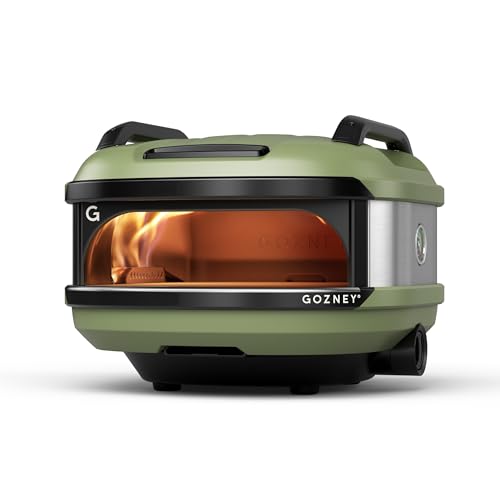
Gozney Tread Portable Pizza Oven, 12 inch
Built around being carried: folding legs, an integrated handle and a shape that fits a car boot. You give up thermal mass, which is the honest trade every truly portable oven makes.
Best for: Camping, tailgating and small balconies.
Check price
Gozney Arc XL Propane Outdoor Pizza Oven
Mass and insulation are what let an oven make the eighth pizza as well as the first. The Arc XL has both, and it is the reason it costs twice what a portable does.
Best for: Regular entertaining, or a permanent outdoor kitchen install.
Check pricePrices change often, confirm on Amazon. As an Amazon Associate we earn from qualifying purchases.
How do the gas ovens compare?
Preheat is the practical time to a launch-ready floor from cold on a mild day. Wind and cold both push these figures up substantially, which is worth knowing before a winter session.
| Oven | Max pizza | Preheat | Price | Chamber |
|---|---|---|---|---|
| Cuisinart CPO-401 | 12 in | 25 to 30 min | $148.00 | Boxy, light |
| Solo Stove Pi Prime | 12 in | 20 to 30 min | $399.99 | Demi-dome |
| Gozney Arc Lite | 14 in | 20 to 30 min | $399.99 | Arched, lighter shell |
| Ooni Koda 16 | 16 in | 20 to 25 min | $498.00 | Wide mouth, L burner |
| Gozney Tread | 12 in | 20 to 25 min | $499.99 | Portable, low mass |
| Gozney Arc XL | 16 in | 25 to 35 min | $999.99 | Arched, heavily insulated |
What can you get for under $200?
The Cuisinart CPO-401 at $148 is the entry to the entire category. Propane, a stone floor and a peel included, and it clears the 700F mark that separates a pizza oven from a hot grill. Below roughly 700F you cannot get enough oven spring fast enough to produce an open, airy rim; above it you are making pizza.
It will not hold temperature across six pizzas. The shell is light, the insulation is minimal, and the stone is thin, so the floor sags after the second or third pie and needs a few minutes of burner time to come back. The practical answer is to cook in rounds rather than continuously. If you are feeding four people, that is a non-issue. If you are feeding twelve, it is the reason to spend more.
What does $400 actually buy?
This is the sweet spot of the category and there are three genuinely good answers at almost the same price.
The Pi Prime at $399.99 is the purest gas design: one fuel, no compromises made to accommodate a wood tray, a demi-dome that recirculates heat onto the floor. If you are certain you will never burn wood, this is the oven that spent all its engineering budget on your use case.
The Gozney Arc Lite at $399.99 brings the Arc chamber shape and Gozney build quality down to a portable price and weight, trading some heat retention across back-to-back bakes for something you can actually move. It takes a wider pie than the 12 inch ovens, which is more useful than it sounds.
The Gozney Roccbox at $399.00 is not gas-only, and that is exactly its argument: it runs propane out of the box and accepts a wood burner later, so it hedges the one decision you are least able to make right now. Its silicone-jacketed shell also stays touchable, which matters more in a small yard with children than any specification on the box.
Is 16 inches worth the upgrade?
It comes down to which pizza you want to eat. Neapolitan is a 230 g to 280 g ball stretched to 10 or 12 inches and baked in 60 to 90 seconds at 850F to 950F. New York style is a 340 g to 400 g ball at 14 to 16 inches, baked at 600F to 700F for 5 to 8 minutes, and it simply does not fit in a 12 inch oven.
There is a second, quieter benefit. A 16 inch chamber gives a turning peel somewhere to go. In a 12 inch oven containing a 12 inch pizza there is barely room to get a turner in beside the pie, and rotating a pizza every 20 seconds is not optional above 700F. Cooks who find small ovens frustrating are usually running into this rather than into anything about temperature.
If you are feeding a crowd, the Ooni Koda 2 Max solves the problem differently again, with two independently controlled burners under a 24 by 21 inch stone so two 12 inch pizzas cook side by side. That removes the production line at a party in a way no single-pizza oven can. Work out what floor size your target pizza needs with the oven size calculator and the ball weight with the dough ball weight calculator.
Who should not buy the Gozney Arc XL?
The Arc XL at $999.99 is the best oven on this page and the wrong purchase for most of the people reading it.
Do not buy it if you cook pizza fewer than twice a month. What the money buys is recovery across a long session, and recovery is invisible when you make three pizzas and stop. On pizza one and two, a $399 oven produces a result you would not pick out in a blind tasting. You would be spending $600 for a benefit that only shows up at pizza number six.
Do not buy it if the oven has to move or be stored indoors between uses. The mass and insulation that make it good make it a two-person lift and effectively a fixture. The Gozney Tread at $499.99 makes the opposite trade on purpose, with folding legs and an integrated handle, and it exists precisely for the person who needs the oven in a car boot.
Do not buy it if you are still failing launches. Far more first-year disasters come from dough sticking to a peel than from anything an oven did, and a $999 oven fails a launch exactly as thoroughly as a $148 one. Work through the launch guide and the launch troubleshooting chart first.
Do not buy it if your bases are dense or your rims will not open. That is a dough problem, not a heat problem, and it is free to fix. Hydration, ball weight and fermentation are the three variables, and the hydration calculator plus cold fermentation guide will move your pizza further than $600 of extra oven.
Do not buy it if you actually want wood. If the fire is the point, buy a multi-fuel oven such as the Karu 12 and read the wood-fired roundup. The Arc XL is an excellent propane oven and it is not trying to be anything else.
Who should buy it: people who entertain regularly, anyone building a permanent outdoor kitchen where the oven never moves again, and cooks who have already worn out a portable and know exactly which limitation annoyed them.
How do you run a gas oven for the best pizza?
Preheat on full for 20 to 30 minutes, then check the floor with an infrared thermometer at $32.99 rather than trusting a dome gauge, which reads the air and can sit 150F above the stone. Aim at the exact spot the pizza will land, not under the flame.
Turn the burner down before you launch. This is the single most useful habit in gas cooking and almost nobody does it at first. At full flame the rear rim scorches while the base is still setting. Dropping to medium for the bake and going back to full for two minutes between pizzas keeps the floor charged without cooking the top too fast.
Rotate every 20 seconds at Neapolitan temperature, every 90 seconds or so at New York temperature. Use the bake time and temperature chart to know what to expect and the bake temp and time calculator to convert between a floor temperature and a bake time.
Propane safety: use the regulator and hose supplied with the oven and check the connection with soapy water before each session, watching for bubbles. Burn outdoors only, never in a garage, tent or under an awning, and keep clearance from anything combustible. Store tanks upright outdoors and never inside a house. Site the oven on a stable, non-combustible surface, ideally a proper stand such as the Ooni modular outdoor table rather than a folding trestle, and use contact-heat rated gloves such as the Grill Armor EN407 gloves when working at the mouth.
What should you buy alongside a gas oven?
Less than with wood, which is part of the value. There is no ash rake, no fuel storage, no firebox to clean. What you do need is a peel to build on, a turning peel at $17.99, an infrared thermometer, a full spare propane tank, and a fitted waterproof cover at $29.99 if the oven lives outdoors. A cordierite stone that soaks up rain and then gets fired will crack from the trapped steam, and that is how a two-year oven becomes a ten-year oven.
The full accessory field with prices is in the accessories roundup, the peel decision is in the peel roundup, and complete priced builds are on the builds hub. If you are still choosing between fuels, start at the fuel guide or the main pizza oven roundup.
Frequently asked questions
What is the best gas pizza oven?
The Solo Stove Pi Prime at $399.99 is the best gas pizza oven for most people. It is built purely around propane, with a demi-dome chamber and a wide mouth, so there is no fuel swapping and no fire management. The dome shape pushes heat back down onto the stone rather than letting it escape out of the opening, which is the reason a gas-only design can beat a multi-fuel oven at the same price.
How much propane does a pizza oven use?
A standard 20 lb tank, the same one a gas grill uses, gives roughly ten to twenty hours of pizza cooking depending on the oven and how hard you run it. A typical session, 30 minutes of preheat plus an hour of cooking, uses a small fraction of a tank. Keep a second tank so you never discover an empty one mid-preheat, and always store tanks upright outdoors.
Can you convert a propane pizza oven to natural gas?
Only if the manufacturer sells a conversion kit for that specific model, and only when fitted according to their instructions. Propane and natural gas run at different pressures and need different orifices, so an improvised conversion is genuinely dangerous. Several ovens offer factory natural gas versions instead of kits, which is the safer route if you have a gas line at the patio.
Do gas pizza ovens taste worse than wood?
At Neapolitan speed the difference is smaller than the marketing suggests. A 60 to 90 second bake is far too fast to absorb meaningful smoke, so most of what people attribute to wood is really the radiant heat pattern of a live flame in a small chamber, which a well-designed gas burner reproduces closely. On longer bakes at 600F to 700F, wood character becomes genuinely noticeable.
How do you control temperature on a gas pizza oven?
With the burner dial and with time, in that order. Preheat on full for 20 to 30 minutes so the stone charges, then turn the burner down before launching so the flame stops scorching the rim while the base catches up. Many people run full power up to the launch, drop to medium during the bake, then go back to full for two minutes to recover the floor between pizzas.
Is a 16 inch gas oven worth the extra money?
It is if you want New York style, which uses a 340 g to 400 g ball stretched to 14 or 16 inches. It is also worth it for a reason people miss: a wider chamber gives a turning peel somewhere to go, which makes rotating the pizza mid-bake far easier. If you only ever cook 10 to 12 inch Neapolitan pies, the extra floor space is money you do not need to spend.
How we choose: we compare published manufacturer specifications, verified owner reviews, and long-established baker's percentage practice. We do not test gear in person. Dough figures are guidance, not a recipe guarantee: flour, water and room conditions all vary, so read your dough as well as the numbers.
Heat safety: a pizza oven at working temperature holds a 700F to 950F floor and a shell hot enough to burn on contact. Use long-handled peels and heat-rated gloves, keep children and pets clear, burn fuel outdoors only with clearance from anything combustible, and never pour water on a hot baking stone. Water flashes to steam instantly and thermal shock cracks stone.
Keeping your own dough and bake numbers? The Dough & Oven Planner is the paid version of these pages: 8 printable worksheets you fill in with your own numbers, plus the full PDF, $29.