The Best Dough Proofing Containers for Pizza
The Vtopmart latching dough proofing boxes at $24.99 for two are the best choice for most home bakers, holding four to six balls per box with a latch that survives a fridge shelf. Size by volume: dough is about 1.1 g per millilitre, so allow roughly twice the dough volume, which means 3,000 g of dough needs about 5.5 litres of container to double cleanly.
A proofing container is not storage, it is an instrument. Its job is to make fermentation something you can read rather than guess at, and to stop the surface of the dough drying into a skin that will not stretch. Get both right and the most common home pizza failures, dense bases and balls that tear when you open them, largely disappear. Everything below follows from two numbers: dough sits at roughly 1.1 g per millilitre, and you want space for it to double.
What is a proofing container actually doing?
Three jobs, in order of how often they get ignored.
First, it holds humidity. Dough that loses surface moisture forms a skin, and a skinned ball does not stretch evenly. It resists in the middle, then tears at whichever spot went thinnest. People blame their technique when the real problem was a bowl covered with cling film in a fridge with a circulation fan. A sealed, latching container solves it completely.
Second, it makes rise measurable. Fermentation is the one stage of pizza making where the correct answer is "when it looks right", and "looks right" is impossible to judge in a mixing bowl with sloping sides, where a 60 percent increase in volume barely changes the level. In a straight-sided container with graduations, doubling is a line you can point at.
Third, it shapes the ball. A dough ball left in a straight-sided compartment relaxes outward into a low disc, which is exactly the shape you want to open. A ball proofed in a round bowl stays domed and tall, and opening it takes more force and more risk of tearing the gas out of the rim.
The picks, by tier

Vtopmart Pizza Dough Proofing Boxes with Latching Lids, 2 Pack
Holds four to six balls per box with a latch that survives a fridge shelf being pulled in and out. Straight sides let a ball spread into a disc, which is the shape you want before stretching.
Best for: Batches of four to twelve balls in a domestic fridge.
Check price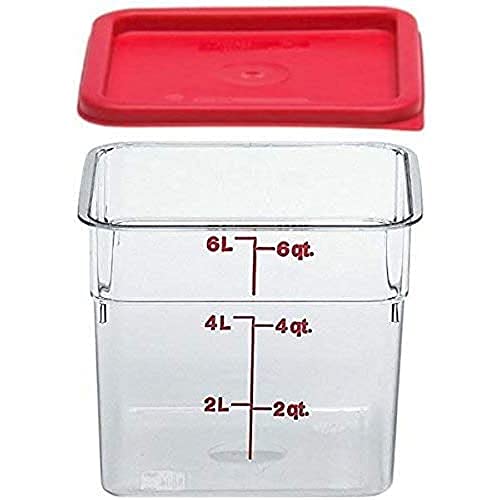
Cambro 6 Quart Camsquare Food Storage Container with Lid
Graduated straight sides turn "has it doubled?" from a guess into a reading. Bulk fermentation is the stage where most home dough goes wrong, and it goes wrong because nobody can see what it is doing.
Best for: Bulk fermenting before dividing into balls.
Check price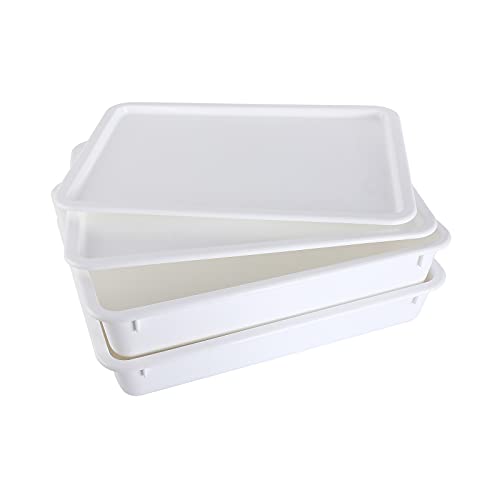
GSM Brands Pizza Dough Proofing Box, 17.25 x 13 inch, 2 Trays and Covers
The standard pizzeria tray footprint, and it stacks so the lid of one box is the floor of the next. That is how you cold ferment eighteen balls without giving up an entire fridge shelf per six.
Best for: Twelve balls and up, or anyone running two dough recipes at once.
Check pricePrices change often, confirm on Amazon. As an Amazon Associate we earn from qualifying purchases.
How big a container do you need?
Work from the dough weight, not from the number of pizzas. Dough is close to 1.1 g per millilitre once mixed, so divide the total weight by 1.1 to get the volume it occupies, then double it to leave room for the rise. That is the entire calculation.
The table below assumes 250 g balls, which is the standard for a 10 to 12 inch Neapolitan pie. New York style at 340 g to 400 g per ball scales the numbers up proportionally, and the dough ball weight calculator will give you the exact ball weight for the diameter you are targeting.
| Balls | Dough weight | Dough volume | Container needed | Practical size |
|---|---|---|---|---|
| 4 | 1,000 g | 910 mL | 1.8 L | 2 quart, or one ball box |
| 6 | 1,500 g | 1,364 mL | 2.7 L | 3 quart, or one ball box |
| 8 | 2,000 g | 1,818 mL | 3.6 L | 4 quart, or two ball boxes |
| 12 | 3,000 g | 2,727 mL | 5.5 L | 6 quart, or one commercial tray |
| 18 | 4,500 g | 4,091 mL | 8.2 L | Two 6 quart, or stacked trays |
Two practical notes. Those figures are for bulk fermentation, where the whole mass rises together. Once the dough is divided into balls in a tray, each ball needs its own footprint but far less headroom, because a proofed ball spreads sideways rather than doubling upward. And a container that is too large is never a problem, while a container that is too small produces dough pressed against the lid, which flattens the top of every ball.
Bulk ferment or ball straight away?
This decides which container you buy first, so it is worth being clear about.
Bulk fermentation means the whole batch rises as one mass, then gets divided and balled shortly before use. Gas distributes evenly through the dough, the mass insulates itself so temperature is steadier, and you only have one container to read. The Cambro 6 quart Camsquare at $25.50 is the standard tool: clear, straight-sided and graduated, so "has it doubled" becomes a reading instead of a guess. It is the container in most pizzerias for exactly this reason.
Ball proofing means dividing immediately after mixing and letting each ball ferment individually in a tray. Each ball gets its full relaxation time, so it opens more easily, and you can pull exactly as many as you want to cook. This is what latching dough boxes at $24.99 for two are built for, holding four to six balls each with straight sides so the balls spread into discs.
Most good home schedules do both: a short bulk at room temperature to get fermentation moving, then divide, ball, and cold proof in trays for 24 to 72 hours. The cold fermentation guide lays out the schedule and the proof time calculator converts between temperature and time. Remember the working rule: yeast activity roughly doubles per 17F rise in dough temperature, so a dough that proofs in 2 hours at 75F takes roughly 4 hours at 58F. It is an approximation, not a law, but it will get you close.
Why do straight sides and graduations matter so much?
Because the alternative is guessing, and most home dough goes wrong at exactly the stage nobody can see. Under-fermented dough gives you a dense base and a rim that will not open. Over-fermented dough goes slack, tears on the peel, and produces a pale, flat pizza. Both look similar in a bowl. Both are obvious against a graduated wall.
The Brod and Taylor 6 litre proofing container at $24.95 goes further, with volume marks moulded into the wall and capacity for up to 3,000 g of dough, and it stacks in a fridge better than a mixing bowl under cling film. If you would rather not read graduations at all, put a rubber band around the outside of the container at the dough line when you start. When the dough reaches double the band height, it is done. That trick costs nothing and works in any straight-sided vessel.
A note on the target: doubling is a convention, not a rule. Many pizza doughs are best at around 50 to 70 percent increase rather than a full double, particularly at higher hydration where a fully doubled dough has already begun to weaken. Watch the dough as well as the mark, and read baker's percentage explained if you want to understand what the yeast percentage is actually doing to the timeline.
Who should not buy the commercial proofing box?
The GSM Brands commercial proofing box at $44.99 is the standard pizzeria tray footprint with two trays and covers, and it stacks so the lid of one is the floor of the next. That is genuinely how you cold ferment eighteen balls without surrendering a fridge shelf per six. It is also the wrong purchase for most home bakers.
Do not buy it if you make four to six balls at a time. A 17.25 by 13 inch tray occupies most of a domestic fridge shelf whether it contains four balls or twelve, so at small batch sizes you are paying a large space cost for capacity you are not using. Two $24.99 latching boxes hold the same dough in less awkward real estate.
Do not buy it without measuring your fridge. This is the single most common return in the category. A commercial tray is sized for a commercial fridge, and plenty of domestic refrigerators cannot take a 17 inch tray flat without removing a shelf entirely, which then costs you the space above and below it.
Do not buy it if you bulk ferment rather than ball early. Trays are for balls. A single mass of dough in a large flat tray spreads out, ferments unevenly at the edges, and is harder to read than the same dough in a tall graduated container. Buy the Cambro instead.
Do not buy it because it looks professional. Nothing about the tray improves the dough. It improves logistics. If your logistics are four balls on a Friday, the tray solves a problem you do not have.
Who should buy it: anyone regularly making twelve balls or more, anyone running two dough recipes side by side, and anyone whose fridge can genuinely take the footprint.
How do you actually load and manage the containers?
Oil lightly, not heavily. A thin film of oil on the base and walls stops the ball welding itself to the plastic, and too much oil fries the base of the ball and makes it slide around when you try to lift it. Wipe the container with an oiled cloth rather than pouring.
Space the balls. Leave at least an inch between balls in a tray, because they spread as they proof and two balls that merge have to be torn apart, which destroys the gas structure in the seam. Six balls in a box built for six is fine; eight in the same box is not.
Lift with a bench scraper at $14.95, not with your fingers. Sliding a thin blade under a proofed ball keeps its shape and its gas. Pulling it out by hand stretches and degasses the exact part of the dough that was going to become your rim. This matters more the higher your hydration goes; above about 62 percent, working without a scraper is genuinely difficult.
Take the dough out of the fridge 1 to 3 hours before you cook, still in the container. Cold dough is stiff, resists opening and tears. The exact time depends on room temperature and ball size, and the proof time calculator will get you close.
Does hydration change the container you need?
Yes, in one specific way: the wetter the dough, the more it spreads and the less it climbs. A 58 to 62 percent Neapolitan dough holds its ball shape and stacks predictably. A 70 to 80 percent Detroit or pan dough flows outward and will merge with its neighbours in a shared tray, which is an argument for individual compartments or for bulk fermenting in a single graduated container and dividing at the end.
Above about 75 percent, for Roman al taglio, most bakers skip ball trays altogether and bulk ferment then transfer straight to the baking tray. Check where your dough sits against the hydration chart and run the recipe through the hydration calculator before deciding how to store it.
One last thing, and it is the cheapest upgrade in this entire category: weigh everything. A 0.1 g digital scale at $16.99 is what makes any of these numbers meaningful, because volume measures of flour vary by up to 20 percent. Pair it with a flour actually suited to your bake, such as Caputo Pizzeria 00 for a 900F oven, and the container will be doing its job on a dough that deserves it. The rest of the kit is in the accessories roundup.
What mixes the dough before it goes in the container
Fermentation control starts before the container. Final dough temperature drives how fast a dough ferments more than anything else you control, which is why the Cuisinart Pro Custom 11 review spends most of its time on the heat a blade adds in 45 seconds, and why the Ooni Halo Core review treats a cooler mix as the practical benefit rather than the gluten development. Measuring that temperature needs a probe, and the ThermoWorks Thermapen ONE review covers the reference tool for it.
Frequently asked questions
What is the best dough proofing container?
For most home bakers, a pair of latching dough boxes such as the Vtopmart two pack at $24.99. Each box takes four to six balls, the latch survives a fridge shelf being pulled in and out, and the straight sides let a ball relax into a disc rather than a dome. For bulk fermentation before dividing, a graduated 6 quart Cambro at $25.50 is the better shape because you can read the rise.
How big a container do I need for pizza dough?
Allow roughly twice the volume of the dough itself. Dough is close to 1.1 g per millilitre, so 1,000 g of dough occupies about 910 mL and wants a container of at least 1.8 litres to double without hitting the lid. Twelve 250 g balls, which is 3,000 g of dough, need about 5.5 litres, which is why the 6 quart size is the standard home bulk container.
Should I bulk ferment or ball straight away?
Both work, and the container follows the choice. Bulk fermenting the whole mass then dividing gives more even gas distribution and lets you read the rise in one graduated container. Balling immediately and cold proofing in trays gives each ball a longer individual relaxation, which makes stretching easier. Most home schedules do a short bulk, then ball, then a long cold proof in a tray.
Why do my dough balls form a skin?
Air movement across the surface, usually in a fridge with a fan. A skinned ball will not stretch evenly and tears at the thin spots. The fix is a sealed container rather than cling film draped over a bowl, since film sags onto the dough and sticks. A latching box or a lidded tray traps enough humidity that the surface stays supple through a 72 hour cold ferment.
How long can pizza dough stay in the fridge?
Typically 24 to 72 hours at 0.05 to 0.2 percent instant yeast, and up to about 96 hours at the low end of that yeast range. Past that the gluten begins to degrade and the dough goes slack and sticky no matter how cold it is. Judge it by feel rather than by the calendar: a ball that has gone soupy and smells sharply alcoholic has gone too far.
Can I just use bowls and cling film?
You can, and it works badly for two reasons. Bowls have curved sides, so a doubling looks like a small change near the rim and you end up guessing. Film sags, touches the dough, and pulls the surface when you remove it. A straight-sided graduated container turns fermentation from a guess into a reading, and that single change fixes more home dough problems than any ingredient upgrade.
How we choose: we compare published manufacturer specifications, verified owner reviews, and long-established baker's percentage practice. We do not test gear in person. Dough figures are guidance, not a recipe guarantee: flour, water and room conditions all vary, so read your dough as well as the numbers.
Heat safety: a pizza oven at working temperature holds a 700F to 950F floor and a shell hot enough to burn on contact. Use long-handled peels and heat-rated gloves, keep children and pets clear, burn fuel outdoors only with clearance from anything combustible, and never pour water on a hot baking stone. Water flashes to steam instantly and thermal shock cracks stone.
Keeping your own dough and bake numbers? The Dough & Oven Planner is the paid version of these pages: 8 printable worksheets you fill in with your own numbers, plus the full PDF, $29.