Ooni Infrared Thermometer Review: $65 for a Temperature Gun?
This gun reads in under 300 milliseconds, comes calibrated for the cordierite stones used in Ooni ovens and has an adjustable emissivity setting so it can also read steel, which is the feature that separates it from every cheap infrared gun. Buy it if you cook on more than one surface material or you want the floor reading to be right rather than roughly right. Skip it if you own one oven with one stone and a tight budget, because a $17 gun will tell you the same story about your floor, just less precisely.
Calibrated for cordierite out of the box, and the one setting that justifies the price.
Specifications
| Calibration | Set for the cordierite baking stones used in Ooni ovens |
|---|---|
| Emissivity | Adjustable, so steel and other finishes can be read correctly |
| Read speed | Under 300 milliseconds |
| Scan mode | Reports minimum, maximum and average surface temperature |
| Stated accuracy | To within 4F |
| Display | High resolution full colour LCD, backlit, with colour coded readout |
| Aiming | Laser guided spot measurement, plus a wider area scan |
| In the box | Batteries included, removable hang loop |
| Listed price | $64.95 |
Specifications above come from Ooni's published product specifications. Treat pricing as approximate, since Amazon pricing moves.
What it does well
- The adjustable emissivity setting is the real feature. An infrared gun infers temperature from emitted radiation, and getting that wrong on a shiny surface produces a reading that is confidently incorrect.
- Scan mode reporting minimum, maximum and average is more useful than a single spot reading, because a pizza oven floor is not one temperature. The centre and the edges can differ by a hundred degrees or more.
- Under 300 milliseconds means you can sweep the floor and watch the numbers move rather than take one reading and hope.
- Colour coding on the display is genuinely practical when you are glancing at it from beside a 900F oven mouth rather than studying it.
- Batteries are in the box and there is a hang loop, so it lives on the oven stand hook rather than in a drawer.
Where it falls short
- It is $64.95 for a tool whose core function is available at $17. The gap is calibration and refinement, not capability.
- Infrared reads surfaces only. It cannot tell you the dough temperature, the air temperature or anything below the surface, and people regularly expect it to.
- Emissivity is a setting you have to actually use. Left on the cordierite value and pointed at a steel plate it will read low, and nothing warns you.
- A stated 4F accuracy is fine for pizza and unremarkable in absolute terms.
- It is oven brand specific in its default calibration, which is a marketing convenience rather than a technical necessity.
What owners report
Owner reports on infrared guns for pizza are consistent about one thing above all: the moment people start measuring their floor rather than trusting the oven's own gauge or a timer, their pizza improves. That is true of a $17 gun and a $65 gun alike, and it is the strongest argument for buying any of them.
Where this model earns its extra money in the reports is on mixed surfaces. Owners who cook on cordierite in an outdoor oven and on a steel plate indoors describe the emissivity adjustment as the reason the readings agree with reality in both places. If you only ever point it at one stone, that advantage does not apply to you. Our infrared thermometer roundup covers the cheaper options, and the preheat time chart shows why the floor lags the air by so much.
Who it suits
- Anyone who owns an outdoor pizza oven and does not currently measure the floor.
- People cooking on both cordierite and steel, where a fixed emissivity gun will be wrong on one of them.
- Owners of ovens with no built in thermometer at all, which includes several popular models.
- Anyone whose first pizza is consistently pale underneath, which is almost always a floor that had not finished climbing.
Who should skip it
- Buyers on a tight budget with a single cordierite stone, who should spend $17 and get most of the benefit.
- People wanting to measure dough or internal temperatures, which needs a probe.
- Anyone who has not yet bought a turning peel, which changes more pizzas than a thermometer does.
- Indoor electric oven owners whose oven controls its own stone temperature.
Alternatives worth considering

TempPro TempScan Dual-Laser Infrared Thermometer
$29.99
Two lasers marking the edges of the measured spot, which removes the main uncertainty with a cheap gun: not knowing exactly what area the reading came from. Less than half the price and it answers the same question.
Check price on Amazon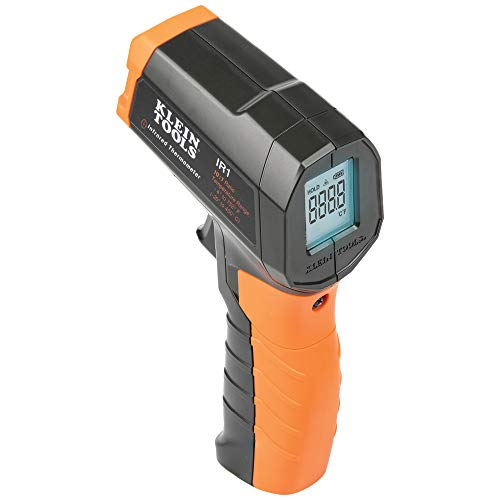
Klein Tools IR1 Infrared Thermometer
$29.98
A trade tool rather than a kitchen one, built to be dropped, with a stated range of minus 4F to 752F. That upper limit is the catch: it will not read a 900F Neapolitan floor, so it suits home oven and steel work rather than an outdoor oven.
Check price on Amazon
ThermoWorks Thermapen ONE Instant-Read Thermometer
$125.00
A probe rather than an infrared gun, so it reads dough and water temperature to plus or minus 0.5F and cannot read a stone floor at all. Buy it second, once the floor is a known quantity.
Check price on AmazonWhere it fits in the rest of the kit
An infrared gun is the instrument that turns your first pizza of the session from a guess into a decision, because it reads the floor rather than the air. The preheat time chart shows how far the stone lags the chamber, which is why so many first pizzas come out pale underneath, and the bake temperature and time calculator turns a measured floor temperature into a bake time you can actually work to.
If you are weighing this against a probe, read infrared versus probe thermometer first, because they are not interchangeable and the Thermapen ONE cannot read a stone floor at any price. Cheaper infrared options are covered in the infrared thermometer roundup. And if you are still setting the oven up, the first fire guide is where the thermometer earns its keep straight away, since the break-in burns are the ones you most need to measure rather than guess.
Keep reading
- Infrared vs probe thermometer
- Best infrared thermometers for a pizza oven
- Bake temperature and time calculator
- Pizza oven preheat time chart
- ThermoWorks Thermapen ONE review
- First fire: breaking in a pizza oven
This review draws on published specifications, manufacturer figures and the consensus of verified owner reviews. We have not tested this product ourselves, and we say so rather than implying otherwise. As an Amazon Associate we earn from qualifying purchases.
Frequently asked questions
Do I need an infrared thermometer for a pizza oven?
If the oven has no floor reading, yes, and it is one of the highest value tools on the bench. Floor temperature is what decides your bake time and which style of pizza you can make, and built in gauges measure the air or the shell rather than the stone. The air in a pizza oven can be hundreds of degrees away from the floor. Measuring the floor turns the first pizza of the session from a guess into a decision.
What is emissivity and why does it matter?
An infrared thermometer does not measure temperature directly. It measures emitted radiation and converts that into a temperature using an assumption about how efficiently the surface radiates, which is its emissivity. Cordierite and bare steel are quite different, so a gun calibrated for one will read the other incorrectly. A fixed emissivity gun is fine if you only ever point it at one material. An adjustable one is right if you use both.
Is a $17 infrared thermometer good enough?
For a single cordierite floor, largely yes. It will tell you whether the stone is at 700F or 850F, which is the decision you are actually making, and that alone will improve your pizza. What you give up is calibration accuracy, the emissivity adjustment and scan mode. If you cook on steel indoors and stone outdoors, the cheap gun will be wrong on one of them and you will not know which.
Where should I point it on the oven floor?
Where the pizza will land, and then in two or three other places. A pizza oven floor is not one temperature: the area under the flame runs much hotter than the mouth, and the spot you launch onto is the one that decides the base. Scan mode is useful for exactly this, since it reports minimum, maximum and average across a sweep rather than a single point.
Ooni infrared thermometer or a probe thermometer?
Infrared, first, without much doubt. The floor temperature is the number that decides the bake and no probe can read it. A probe answers a different and later question, which is what temperature your dough finished mixing at and therefore how fast it will ferment. Both are useful. Only one of them changes the pizza that comes out of the oven tonight.
How we choose: we compare published manufacturer specifications, verified owner reviews, and long-established baker's percentage practice. We do not test gear in person. Dough figures are guidance, not a recipe guarantee: flour, water and room conditions all vary, so read your dough as well as the numbers.
Heat safety: a pizza oven at working temperature holds a 700F to 950F floor and a shell hot enough to burn on contact. Use long-handled peels and heat-rated gloves, keep children and pets clear, burn fuel outdoors only with clearance from anything combustible, and never pour water on a hot baking stone. Water flashes to steam instantly and thermal shock cracks stone.
Keeping your own dough and bake numbers? The Dough & Oven Planner is the paid version of these pages: 8 printable worksheets you fill in with your own numbers, plus the full PDF, $29.