The Best Infrared Thermometers for a Pizza Oven
The TempPro TempScan dual-laser infrared thermometer at $32.99 is the best pick for a pizza oven, because its two lasers mark the edges of the measured spot so you know you are reading the centre of the stone and not the flame behind it. For a Neapolitan bake you need a gun that reads past 1,000F, since the floor sits at 850F to 950F.
An infrared thermometer is the cheapest instrument that changes how your pizza comes out, because it answers the one question every other tool guesses at: is the floor ready. The dial welded to your oven reads the dome or the air, both of which reach temperature long before the stone does. Launch on that signal and you get the classic failure, a blistered rim over a pale, floppy base. Read the floor instead and the problem disappears.
Why does the built-in gauge lie to you?
It is not lying, it is measuring something else. Most oven-mounted thermometers sit in the dome or the chimney throat, where they read the hot gas moving through the chamber. Gas heats up in minutes. A dense cordierite slab takes half an hour or more to charge, because heat has to conduct all the way through it rather than simply swirl around it.
That gap between dome and floor is largest exactly when it matters most: during preheat. It is routine for a wood-fired oven to show 900F on the dome gauge while the launch spot is still below 700F. It also reappears after every pizza, when a cold, wet disc has just pulled several hundred BTU out of one patch of the floor and the dome barely noticed.
An infrared thermometer measures the radiation coming off a surface and converts it to a temperature. Point it at the stone and you get the number that predicts your bake. That is the whole value proposition, and it costs about $33.
The picks, by tier

Etekcity Infrared Thermometer Laser Temperature Gun 774
Cheap, quick and good enough to tell 650F from 800F, which is the decision the tool exists to make. Check the top of its range before buying: many budget guns stop below Neapolitan floor temperature.
Best for: A first IR gun for a home oven, grill or moderate outdoor oven.
Check price
TempPro TempScan Dual-Laser Infrared Thermometer
Two lasers mark the edges of the measured spot, so you know you are reading the centre of the stone rather than the flame behind it. That single feature removes most bad readings.
Best for: Outdoor pizza ovens, where aiming at the wrong spot is the main error.
Check price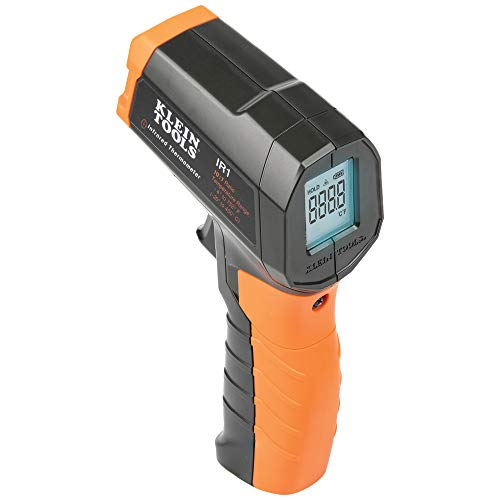
Klein Tools IR1 Infrared Thermometer
A trade tool rather than a kitchen gadget, with a 10:1 distance-to-spot ratio and a housing that survives being dropped on a patio. Check the range suits your oven before buying.
Best for: Anyone who wants one gun for the oven, the grill and the house.
Check price
ThermoWorks Thermapen ONE Instant-Read Thermometer
A different instrument for a different job: this reads dough temperature and final dough temp, which is what actually controls fermentation. An IR gun cannot read inside anything.
Best for: Bakers who want to control dough temperature rather than guess at it.
Check pricePrices change often, confirm on Amazon. As an Amazon Associate we earn from qualifying purchases.
How do these thermometers compare?
Ranges below are the published manufacturer figures for each tool. The Thermapen is included for contrast: it is a probe, not an infrared gun, and it does a different job.
| Tool | Type | Price | Lasers | What it is for |
|---|---|---|---|---|
| Etekcity 774 | Infrared | $18.99 | 1 | Home ovens, grills, moderate outdoor ovens |
| Klein Tools IR1 | Infrared | $29.98 | 1 | One rugged gun for oven, grill and house |
| TempPro TempScan | Infrared | $32.99 | 2 | Pizza oven stone floors specifically |
| ThermoWorks Thermapen ONE | Probe | $125.00 | 0 | Dough temperature and fermentation control |
What does distance to spot ratio actually change?
An infrared thermometer does not measure a point. It measures a cone, and it reports the average temperature of everything inside that cone where it meets a surface. Distance to spot ratio tells you how wide that circle is. At 10:1, standing 20 inches back gives you a 2 inch measured circle. At 8:1, the same distance gives you 2.5 inches.
In a pizza oven this is not an academic detail. A 12 inch chamber has a flame at the back, a hot patch under it, a cooler patch at the mouth, and the launch zone somewhere in between. If your measured circle is six inches wide, you are averaging across all of that and the number means very little. Get close, keep the circle small, and read the exact square where the pizza will land.
This is the argument for the dual-laser design on the TempPro TempScan . A single laser dot shows you the centre of the cone and tells you nothing about its width, so you are guessing at coverage. Two lasers converge to mark the edges of the measured spot, which turns aim from a guess into something you can see. For a tool whose main failure mode is aiming at the wrong thing, that is the feature worth the extra few dollars.
What temperature range do you need?
Match the tool to the oven, and check the top of the range before anything else. This is where cheap infrared guns quietly fail buyers.
If you cook in a home oven on a stone or a steel plate , your ceiling is 550F and any thermometer in this category clears it comfortably. The Etekcity 774 at $18.99 is entirely adequate and there is no reason to spend more.
If you run a gas portable at New York temperatures, roughly 600F to 700F, most budget guns are still fine. If you are chasing Neapolitan in a Roccbox or an Arc XL , you need a tool that reads well past 1,000F, because the floor sits at 850F to 950F and the dome and flame front go higher. Buying a gun that tops out at 750F for a Neapolitan oven means the instrument shows an error exactly at the moment you most need a number.
The Klein Tools IR1 at $29.98 is worth a look for a different reason: it is a trade instrument rather than a kitchen gadget, with a housing built to survive being dropped on a patio, and it will also find the draught in your window frames in winter. Check its range against your oven before ordering.
How do you take a reading that means something?
Aim at the launch spot, not the centre of the oven and never directly under the flame. In most portables the pizza lands just forward of centre, and that is the square you care about.
Take three readings, not one: the launch spot, the back of the stone near the burner, and the front lip near the mouth. The spread between them tells you how the oven is behaving. A 150F spread front to back is normal in a small chamber and tells you the pizza will need turning every 20 seconds. A 350F spread means the oven has not finished soaking and you should wait five more minutes rather than launch.
Do not point it at metal. Shiny stainless and clean carbon steel reflect infrared rather than emit it, and the reading can be hundreds of degrees low. Cordierite, firebrick and a seasoned, darkened steel all read close to correctly. If you must know the temperature of a bright metal surface, a strip of high-temperature tape or a patch of soot gives the gun something honest to read.
Re-read between pizzas. This is the habit that separates people who cook one good pizza from people who cook eight. A minute of burner time after each bake, verified with a two second check, keeps the whole session consistent. Use the oven temperature by pizza style chart to know what you are aiming for and the bake temp and time calculator to convert a temperature into an expected bake time.
Using a gun at the mouth: never look into the laser or point it at anyone's eyes, and never lean into the opening to get a closer reading. Take the measurement from outside the mouth at an angle, wear contact-heat rated gloves such as the Grill Armor EN407 gloves if you are working near the shell, and keep the plastic body of the thermometer well clear of the opening. These tools melt.
Who should not buy the Thermapen ONE?
The ThermoWorks Thermapen ONE at $125 is a superb instrument and it is the wrong first purchase for most people on this page. Be clear about why.
Do not buy it expecting it to replace the infrared gun. It cannot read a stone floor. It is a probe: it measures the inside of things it is stuck into. If your problem is knowing when the oven is ready, this tool does not solve it at any price, and a $18.99 infrared gun does.
Do not buy it if you are not yet weighing ingredients. Dough temperature control is a refinement that sits on top of accurate weights, not underneath them. If you are still measuring flour in cups, a 0.1 g scale at $16.99 will improve your pizza roughly ten times more per dollar than a $125 probe. Volume measures of flour vary by up to 20 percent, which is enough to shift a dough from 65 percent hydration to 55 without you noticing.
Do not buy it if you make one dough recipe at the same time in the same kitchen every week. Its real value is repeatability across changing conditions, and if your conditions never change, your dough already is repeatable.
Who should buy it: bakers who are running long cold ferments, who mix in a machine where friction raises dough temperature unpredictably, or who have noticed the same recipe behaving completely differently in summer and in winter. Yeast activity roughly doubles for every 17F rise in dough temperature, so a dough finishing at 82F instead of 75F is not a small difference, it is a halving of your proof time. That is the problem this tool solves, and the proof time calculator is where the number goes once you have it.
Is your home oven lying to you as well?
Almost certainly, and this is the first thing most people discover once they own one of these tools. Domestic ovens are routinely 25F to 50F away from their set point, and some are worse. They also cycle: the element fires, the air overshoots, the element cuts, the air drifts down, and the thermostat reports an average of that cycle rather than the temperature at any given instant.
A stone or a steel plate smooths all of that out, because a dense slab cannot follow a cycling air temperature. That is one of the quieter reasons a heavy baking surface improves home pizza: it converts an unstable oven into a stable cooking surface. But it also means the slab settles at whatever the oven's true average is, not at the number on the dial, which is exactly what an infrared thermometer is for.
Check yours once. Set the oven to its maximum with the slab inside, wait a full hour, and read the surface. If you have been assuming 550F and the plate reads 495F, that single measurement explains a long history of pale bases and it costs nothing to correct: bake longer, move the rack higher, or finish under the broiler for the last 60 to 90 seconds. Nothing else in your process needs to change.
Do the same check on an outdoor oven at the start of each season. A stone that has been stored over winter, a burner with a partially blocked port, or simply a windy day will all shift your real numbers, and the gun turns that from a mystery into a reading.
What else does an infrared gun earn its keep on?
More than pizza, which helps justify the purchase. It reads a cast iron pan before a sear, a grill grate before steak goes on, the surface of a baking steel before bread, and the oil in a fryer without dipping anything into it. Outside the kitchen it finds cold spots in walls, an overheating breaker, and whether your hot water is actually arriving hot.
If you are assembling a first kit, the gun belongs in it alongside a peel, a turning peel and rated gloves. The complete lists at three budgets are on the beginner setup and expert setup pages, and the full accessory field is covered in the accessories roundup. If you have not chosen an oven yet, start with the pizza oven roundup.
Full reviews of the thermometers in this roundup
The Ooni infrared thermometer review covers the emissivity setting, which is the feature that separates a $65 gun from a $17 one and the reason a reading off a steel plate can be confidently wrong. The ThermoWorks Thermapen ONE review covers the reference probe and states the limitation plainly: it cannot read your oven floor, and for pizza alone it is a luxury.
Frequently asked questions
Do I need an infrared thermometer for a pizza oven?
If your oven runs past 700F, yes. The built-in dial on most ovens reads the air or the dome, and the pizza cooks on the floor, which can sit 150F below the dome during a preheat. Launching on a floor that is not charged is the most common cause of a burnt rim over a pale, floppy base. A $32.99 gun turns readiness from a guess into a two second check.
What is distance to spot ratio?
It describes how wide an area the thermometer averages at a given distance. A 10:1 ratio means that from 20 inches away the reading covers a 2 inch circle. Stand further back and you average a larger patch, which for a pizza oven can quietly include the flame or the cold edge of the stone. For oven work, get close enough that the measured spot is smaller than your launch zone.
What temperature range does a pizza oven thermometer need?
At least 1,000F if you cook Neapolitan, because the floor sits at 850F to 950F and the dome runs higher still. Many budget infrared guns stop around 750F to 850F, which is below the range you most need to read. Check the top of the range before buying rather than the headline price. For a home oven with a steel, capped at 550F, almost any gun on the market is sufficient.
Does emissivity affect the reading on a pizza stone?
It does, but far less than people fear. Infrared thermometers assume a fixed emissivity, usually 0.95, and cordierite and firebrick sit close to that, so readings on a stone floor are generally trustworthy. Shiny metal is where these tools fail badly: pointing one at a bare stainless surface or a clean steel plate can read hundreds of degrees low. Read the stone, not the shell.
Is an instant-read probe better than an infrared gun?
They are not substitutes, they measure different things. An infrared gun reads the surface temperature of a solid it can see, which is what you need for a stone floor. A probe reads inside something, which is what you need for dough temperature and final dough temperature, the figures that actually control fermentation speed. Serious bakers end up owning both, and the gun first.
How accurate are cheap infrared thermometers?
Typically within about 2 percent of the reading or a few degrees, whichever is larger, which at 900F can mean a spread of 18F or more. That sounds bad and mostly is not, because you are making a coarse decision: is this floor at launch temperature or not. Where cheap guns really fail is range and aim, not precision, so buy for the top of the range and for dual lasers.
How we choose: we compare published manufacturer specifications, verified owner reviews, and long-established baker's percentage practice. We do not test gear in person. Dough figures are guidance, not a recipe guarantee: flour, water and room conditions all vary, so read your dough as well as the numbers.
Heat safety: a pizza oven at working temperature holds a 700F to 950F floor and a shell hot enough to burn on contact. Use long-handled peels and heat-rated gloves, keep children and pets clear, burn fuel outdoors only with clearance from anything combustible, and never pour water on a hot baking stone. Water flashes to steam instantly and thermal shock cracks stone.
Keeping your own dough and bake numbers? The Dough & Oven Planner is the paid version of these pages: 8 printable worksheets you fill in with your own numbers, plus the full PDF, $29.