The Best Portable Pizza Ovens, Ranked by What You Actually Carry
The Ooni Karu 12 at $248.95 is the best portable pizza oven for most people: 26.4 lb, about a 15 minute preheat, and it burns wood or charcoal without needing a propane supply. Anything under roughly 45 lb is a genuine one-person carry, and the specification that actually shapes a trip is cool-down, which runs 45 to 90 minutes before the oven can be handled.
Portable is a marketing word attached to almost every outdoor pizza oven sold, so it needs a definition before it is useful. A portable oven is one that one person can carry at a normal walking pace, that needs no assembly at the far end, and that does not depend on a fuel supply you cannot bring with you. By that test the field narrows quickly, and it narrows on published weight and fuel rather than on temperature.
What does portable actually mean for a pizza oven?
Four specifications decide it, and only one of them appears on the front of the box.
Weight. Roughly 45 lb is the line where a hot, awkwardly shaped metal box stops being carried and starts being moved. The lightest oven on this page is the Ooni Koda 12 at 20.4 lb, which genuinely goes under one arm. The Gozney Roccbox at 44 lb is right on the boundary, and the Gozney Arc XL at 71 lb is not portable by any honest reading of the word.
Setup at the far end. A gas oven with a fixed burner is out of a car and lighting inside two minutes. A multi-fuel oven with a chimney, a firebox and a door needs the parts kept together and reassembled, which is fine in a garden and irritating in a car park.
Fuel independence. Gas is convenient at home and a logistics problem away from it, because a 20 lb propane cylinder is heavier than most of these ovens. Wood and charcoal ovens are heavier to run in one sense and lighter in another: fuel can be bought locally, or is already on site. That is the strongest practical argument for a multi-fuel oven if the thing is genuinely going to travel.
Cool-down. The forgotten one. Nobody publishes it, and it is the specification that shapes an actual trip. Expect 45 to 90 minutes before a portable oven can be handled, and longer before it belongs in the boot of a car. If you are cooking at a campsite at dusk, that is the difference between packing up in the light and packing up in the dark.
The picks, by tier

Cuisinart CPO-401 Outdoor Pizza Oven
The cheapest way to find out whether you actually want to make pizza every weekend. It ships with a stone and a peel, runs on a standard propane tank, and clears the 700F mark that separates a real pizza oven from a hot grill.
Best for: A first outdoor oven, or a small patio where a $500 oven is hard to justify.
Check price
Ooni Karu 12 Multi-Fuel Outdoor Pizza Oven
Burns wood or charcoal out of the box and takes a bolt-on gas burner, which is the honest way to learn fire management: you can always fall back to gas on a weeknight.
Best for: Learning to cook with wood without being locked into it every time.
Check price
Gozney Roccbox Outdoor Pizza Oven, Gas and Wood Fired
A thick stone floor and a silicone-jacketed shell that stays touchable, which is unusual and genuinely useful in a small yard. Runs propane out of the box and takes a wood burner later, so it covers both ways of cooking without a second purchase.
Best for: The one oven most home bakers should buy and keep for a decade.
Check price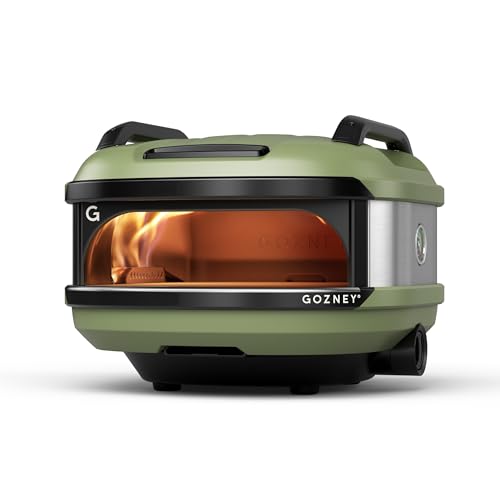
Gozney Tread Portable Pizza Oven, 12 inch
Built around being carried: folding legs, an integrated handle and a shape that fits a car boot. You give up thermal mass, which is the honest trade every truly portable oven makes.
Best for: Camping, tailgating and small balconies.
Check pricePrices change often, confirm on Amazon. As an Amazon Associate we earn from qualifying purchases.
How do the portable ovens compare on weight and preheat?
Weights below are manufacturer published figures for the oven body, not the shipping weight and not including a gas cylinder, a stand or a cover. Preheat is to a usable floor temperature. Where a figure has not been published we leave it blank rather than estimate one.
| Oven | Fuel | Weight | Preheat | Usable pizza | Claimed max | Price band |
|---|---|---|---|---|---|---|
| Ooni Koda 12 | Gas | 20.4 lb | 15 min | 11 in | 950F | $300 to $400 |
| Ooni Fyra 12 | Wood pellet | 22 lb | 15 min | 11 in | 950F | $200 to $300 |
| Ooni Karu 12 | Wood, charcoal or gas | 26.4 lb | 15 min | 11 in | 950F | $200 to $300 |
| Solo Stove Pi Prime | Gas | 30.5 lb | 15 min | 11 in | 950F | $300 to $400 |
| Ooni Koda 16 | Gas | 40.1 lb | 20 min | 15 in | 950F | $400 to $500 |
| Gozney Roccbox | Gas, wood optional | 44 lb | 15 min | 12 in | 950F | $300 to $400 |
| Gozney Tread | Gas | Not published | 20 min | 11 in | 950F | $400 to $500 |
| Gozney Arc XL | Gas | 71 lb | 30 min | 15 in | 950F | $900 and up |
The pattern in that table is the entire category in one view. Claimed maximum temperature is effectively constant, preheat varies by only a few minutes, and weight varies by more than three times. Weight is where the real decision lives, and it is inversely related to the one thing portable ovens are genuinely worse at, which is holding the floor temperature across back-to-back bakes.
What do you give up by buying a light oven?
Thermal mass, and therefore recovery. This is not a defect and it is not brand-specific, it is physics: the heat that cooks the base of the pizza is stored in the stone, a cold wet disc of dough takes a large slice of it, and a thin stone in a light shell has less in reserve.
In practice a 20 lb to 30 lb oven loses somewhere around 100F to 150F of floor temperature on the first pizza and needs two to four minutes to come back. A heavier, better-insulated oven recovers in under a minute. Nothing about the pizza changes if you simply wait, so the honest way to describe the trade is that a light oven costs you time between pizzas rather than quality.
That matters if you cook for a crowd and it does not matter at all if you cook two or three pizzas for a family. Measure rather than guess: point a dual-laser infrared thermometer at $32.99 at the centre of the floor between bakes and launch when it is back, not when the timer says so. The preheat time chart has the recovery figures by oven class.
Two more real trade-offs. A light oven is more affected by wind, because there is less mass to buffer a gust that pulls flame out of the mouth: set up with the opening away from the prevailing wind. And a light oven is easier to knock over, which is a much bigger deal than it sounds at 900F.
Who should not buy the Gozney Tread?
The Gozney Tread at $499.99 is the expert tier here because it is the only oven on the page designed from the outside in around being carried: folding legs, an integrated handle and a shape that goes into a car boot. It is also the wrong purchase for several readers, and a roundup that will not say so is not doing its job.
Do not buy it if the oven is never going to leave your patio. You are paying a premium for packability, and if it stays in one place that premium buys nothing. Weight would serve you better, which is what the Roccbox at $399.00 and the Arc XL at $999.99 sell.
Do not buy it if you want the cheapest way to cook pizza away from home. The Cuisinart CPO-401 at $148.00 reaches a 700F floor on a standard propane cylinder and travels perfectly well. It gives up recovery and build quality, not the ability to make pizza.
Do not buy it if you want 16 inch pizzas. The Tread is a 12 inch oven with about 11 inches of genuinely usable floor once a turning peel needs room. Nothing you do to a 12 inch chamber makes a 16 inch pie fit, and that trade is worked through on the 12 inch versus 16 inch comparison.
Do not buy it if you want to burn wood. It is gas only. If fire is part of what you want from the trip, the Ooni Karu 12 at $248.95 is both cheaper and the correct tool, and it accepts a gas burner for the evenings when you cannot be bothered.
Who should buy it: someone who genuinely transports an oven several times a season, cooks 12 inch pizzas, and wants Gozney build quality in something they can lift alone.
What do you need to take with a portable oven?
The oven is the easy part. What ruins a trip is arriving with dough and no way to launch it.
Dough boxes, $24.99. Latching dough proofing boxes hold four to six balls each and survive being slid around a cool box. Dough carried loose in a bag arrives as one fused mass. Keep it cold on the way and let it come up to room temperature for two hours before you stretch.
A prep surface, $44.98. A bamboo peel doubles as the build surface, the launcher and the serving board, which is exactly the kind of triple duty that matters when everything has to fit in a car. Away from home, pizza screens at $27.99 for five are worth bringing even if you never use them at home: an unfamiliar table and a rushed build is where launches fail.
A turning peel, $17.99. At 900F one edge cooks in about 20 seconds and the pie needs spinning three or four times. A 7 inch round turner is not optional in any oven that runs past 700F.
Rated gloves, $29.95. EN407 certified gloves matter more away from home than at home, because you will be handling a hot oven you are about to pack. Five fingers rather than a mitt, so you can actually grip a handle.
A cover, $29.99. A waterproof oven cover keeps rain out of a cordierite stone, and a stone that absorbs water and is then fired will crack from the trapped steam. Match the cover to your exact model before ordering. If you run a pellet oven, bring food-grade hardwood pizza oven pellets at $15.95 rather than heating pellets, which are not made to be burnt under food.
The complete kit with a running total is on the beginner build, and the full accessory field is on the accessories roundup.
How do you set up a portable oven safely away from home?
Level, solid and non-combustible, in that order. The most common backyard and campsite accident is not a burn from the mouth of the oven, it is an oven going over because it was stood on a folding table, soft ground or a slope. A 900F oven on its side is a serious incident.
Give the oven clearance in every direction, including above. A chimney throws heat and sparks upward, so an awning, a gazebo, a tree canopy or a caravan roof is a real hazard rather than a theoretical one. Keep the opening pointed away from the prevailing wind, both because a gust pulls the flame and because it pushes heat back out at whoever is launching.
Check the fire rules before you travel. A wood or charcoal oven is an open fire in most jurisdictions and is prohibited under a fire ban, while a sealed gas burner frequently is not. That distinction can decide which oven you should own if travel is the main use case.
Portable does not mean cool. The floor runs at 700F to 950F and the shell burns on contact. Burn fuel outdoors only, with clearance from fences, decking, awnings and overhanging branches. Use long-handled peels and EN407 rated gloves, keep children and pets well back, and never pour water on a hot stone: the steam scalds and the thermal shock cracks the stone. Let the oven cool for 45 to 90 minutes before handling it, and never load a warm oven into an enclosed car.
Which portable oven should you actually buy?
If the oven will travel, buy the Ooni Karu 12 at $248.95. It is 26.4 lb, it preheats in about 15 minutes, and burning wood or charcoal means you are not tied to carrying a propane cylinder. That combination is what makes it the default answer.
If it will mostly stay home but has to be stored indoors, buy the Gozney Roccbox at $399.00. At 44 lb it is at the limit of one-person carrying, and in exchange you get a thick stone floor and a silicone-jacketed shell that stays touchable, which is genuinely useful in a small yard.
If it is gas only and never moves, stop reading this page: buy on recovery instead, which is what the gas oven roundup and the Solo Stove Pi Prime at $399.99 are about. If the budget is the binding constraint, the under $300 roundup is the right page, and the beginner roundup covers what to buy alongside whichever oven you pick. For a 16 inch chamber on gas, the Ooni Koda 16 at $498.00 is the one to compare against, using the Ooni versus Gozney comparison.
Frequently asked questions
What is the best portable pizza oven?
The Ooni Karu 12 at $248.95 is the best portable pizza oven for most people. At 26.4 lb it is a genuine one-person carry, it preheats in about 15 minutes, and it burns wood or charcoal out of the box with an optional gas burner, so it is not tied to a propane supply you might not have at a campsite. The Gozney Tread at $499.99 is easier to carry and costs twice as much.
How much does a portable pizza oven weigh?
Between roughly 20 lb and 45 lb for anything genuinely described as portable. The Ooni Koda 12 is 20.4 lb, the Ooni Karu 12 is 26.4 lb, the Solo Stove Pi Prime is 30.5 lb, the Ooni Koda 16 is 40.1 lb and the Gozney Roccbox is 44 lb. Past about 45 lb an oven stops being carried and starts being moved, which is a different activity. The Gozney Arc XL at 71 lb is a two-person lift.
How long does a portable pizza oven take to cool down?
Between 45 and 90 minutes before it can be handled, and longer before it should be packed into a car. This is the specification nobody publishes and the one that actually shapes a trip. Plan to cook first and pack last, keep a heat-rated glove available the whole time, and never load a warm oven into an enclosed space. A stone that is still hot will also crack if it meets cold rain on the way out.
Can you take a pizza oven camping?
Yes, with two conditions. Check whether the site has a fire ban, because a wood or charcoal oven counts as an open fire in most jurisdictions while a sealed gas burner often does not. And bring a stable, non-combustible surface to stand it on. A folding camp table is the most common cause of a tipped oven, and a tipped oven at 900F is a serious incident rather than a spill.
Do portable pizza ovens run on small propane canisters?
Most gas models ship with a regulator and hose for a standard 20 lb refillable cylinder, and many accept an adapter for 1 lb camping canisters. The 1 lb canisters are convenient and expensive per hour, and they can frost up and lose pressure in cold weather, which shows up as an oven that will not hold temperature. For anything longer than a single session, bring the larger cylinder.
Is a portable pizza oven worth it if it never leaves the garden?
Often yes, because portability buys storage as much as travel. A 26 lb oven lives in a cupboard or a shed over winter, which means it is not sitting outdoors absorbing rain into a cordierite stone that will crack on the next firing. What you give up is thermal mass, so the floor sags after three or four pizzas. If the oven has a permanent home and you cook for crowds, buy weight instead.
How we choose: we compare published manufacturer specifications, verified owner reviews, and long-established baker's percentage practice. We do not test gear in person. Dough figures are guidance, not a recipe guarantee: flour, water and room conditions all vary, so read your dough as well as the numbers.
Heat safety: a pizza oven at working temperature holds a 700F to 950F floor and a shell hot enough to burn on contact. Use long-handled peels and heat-rated gloves, keep children and pets clear, burn fuel outdoors only with clearance from anything combustible, and never pour water on a hot baking stone. Water flashes to steam instantly and thermal shock cracks stone.
Keeping your own dough and bake numbers? The Dough & Oven Planner is the paid version of these pages: 8 printable worksheets you fill in with your own numbers, plus the full PDF, $29.